Which strategy timeframe fits your prop account?
Traders argue about timeframes as if one of them were correct. On a funded account the question is more practical: each timeframe changes four operational realities of the account, and the right choice depends on which of those realities you can live with.
What actually changes with the timeframe
Trade frequency. A three-minute strategy can produce multiple entries in a session; a one-hour swing setup might act twice a week. Frequency drives how quickly your statistics converge — and how quickly a bad streak shows up on the account dashboard.
News exposure. Intraday styles can be flat before scheduled releases. Multi-day swing positions on CFDs hold through them by design, which is why swing systems are built around hardcoded stops and targets rather than session-flat rules.
Daily consistency. Some prop firms score how evenly your profit distributes across days. High-frequency styles smooth that curve naturally; low-frequency styles concentrate P&L into fewer, larger days.
Screen involvement. This is the honest one. The shorter the timeframe, the more a manual trader interferes — which is exactly why every strategy in our catalog ships with entries, exits, stops and sizing written into the code, regardless of timeframe.
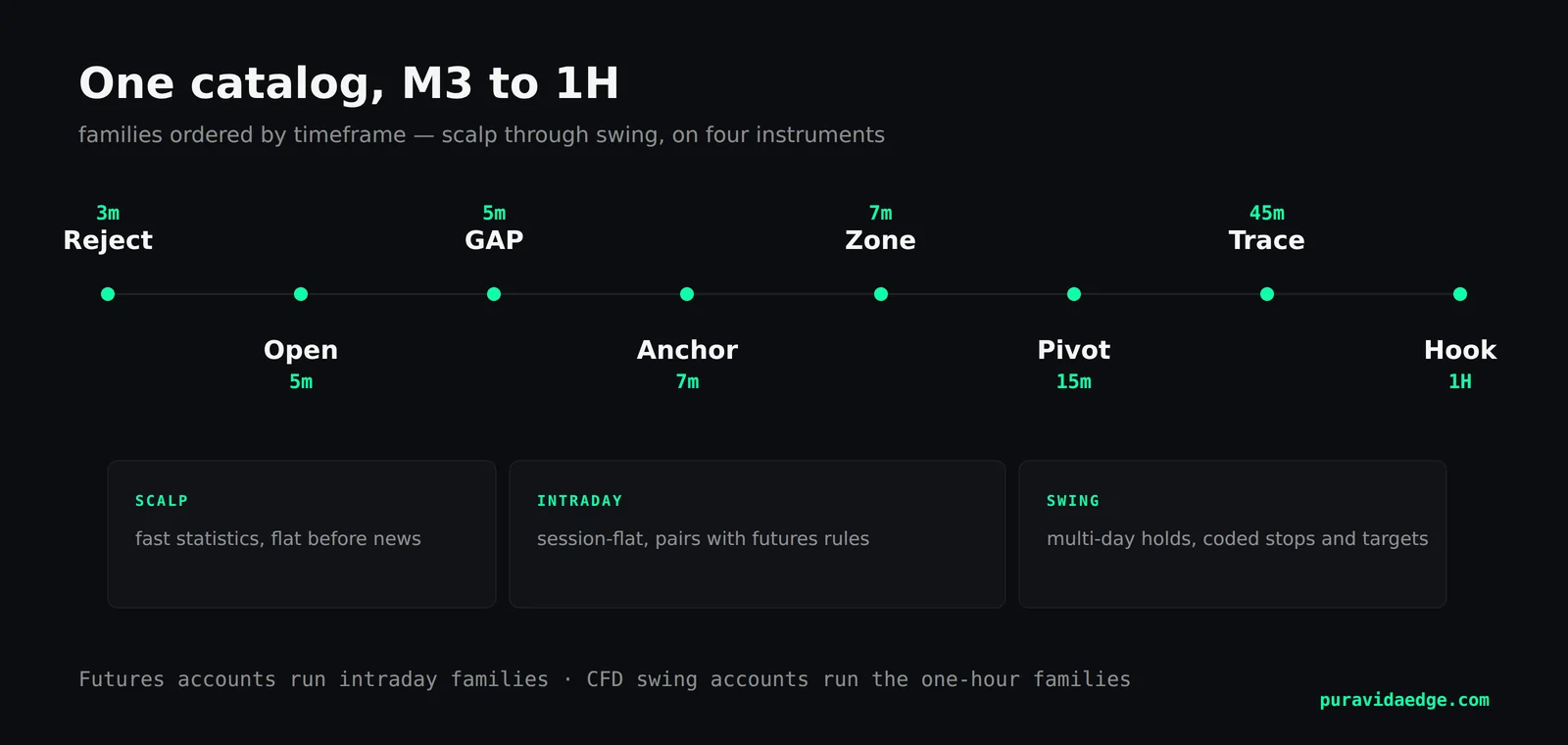
One catalog, every style
Our catalog covers the full spectrum deliberately: families from three-minute execution up to one-hour swing, across four instruments — Nasdaq and gold, as micro futures and as CFDs. The point is not that one style wins. The point is that the style should match your account’s rules and your tolerance, not the vendor’s single flagship product.
Futures and CFDs also split along this line. Futures accounts typically enforce end-of-day flatness, which pairs naturally with intraday families. CFD swing accounts allow multi-day holds, which is where the one-hour families live — protected by stops and drawdown limits coded before the entry, not by someone watching a screen.
Combining styles on a single account
Families in the catalog are individual signal sources — one instrument, one logic. Portfolios are combinations of them running on the same funded account. Mixing timeframes inside one portfolio interleaves the trade streams: the fast family fills the quiet weeks of the slow one, and the slow family caps the daily concentration of the fast one. That interleaving, not any single strategy, is what produces the smoother account-level curve.
Where to start
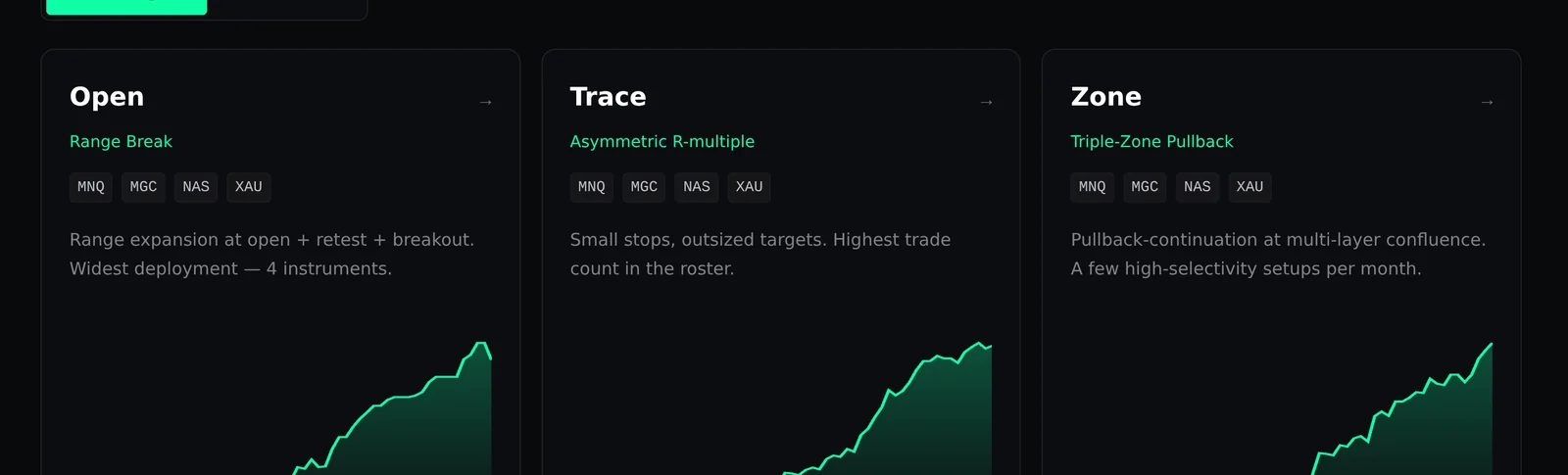
Every family has a public publication page on TradingView with its own Strategy Tester — you can read the character of each style before paying anything.
Every family that joins the catalog arrives for Lifetime holders automatically — pricing and current catalog on the pricing page.
Educational content. Trading futures and CFDs carries substantial risk of loss. Past performance does not guarantee future results. Not financial advice.
The method, applied to the whole catalogue.
Every strategy and portfolio with modeled and live shown separately and the forecast behind each one. One PDF, then our letters with what the systems did.
By email, from Puerto Viejo, Costa Rica. Unsubscribe anytime.