What a 2005 study of Chicago pit traders says about your funded account
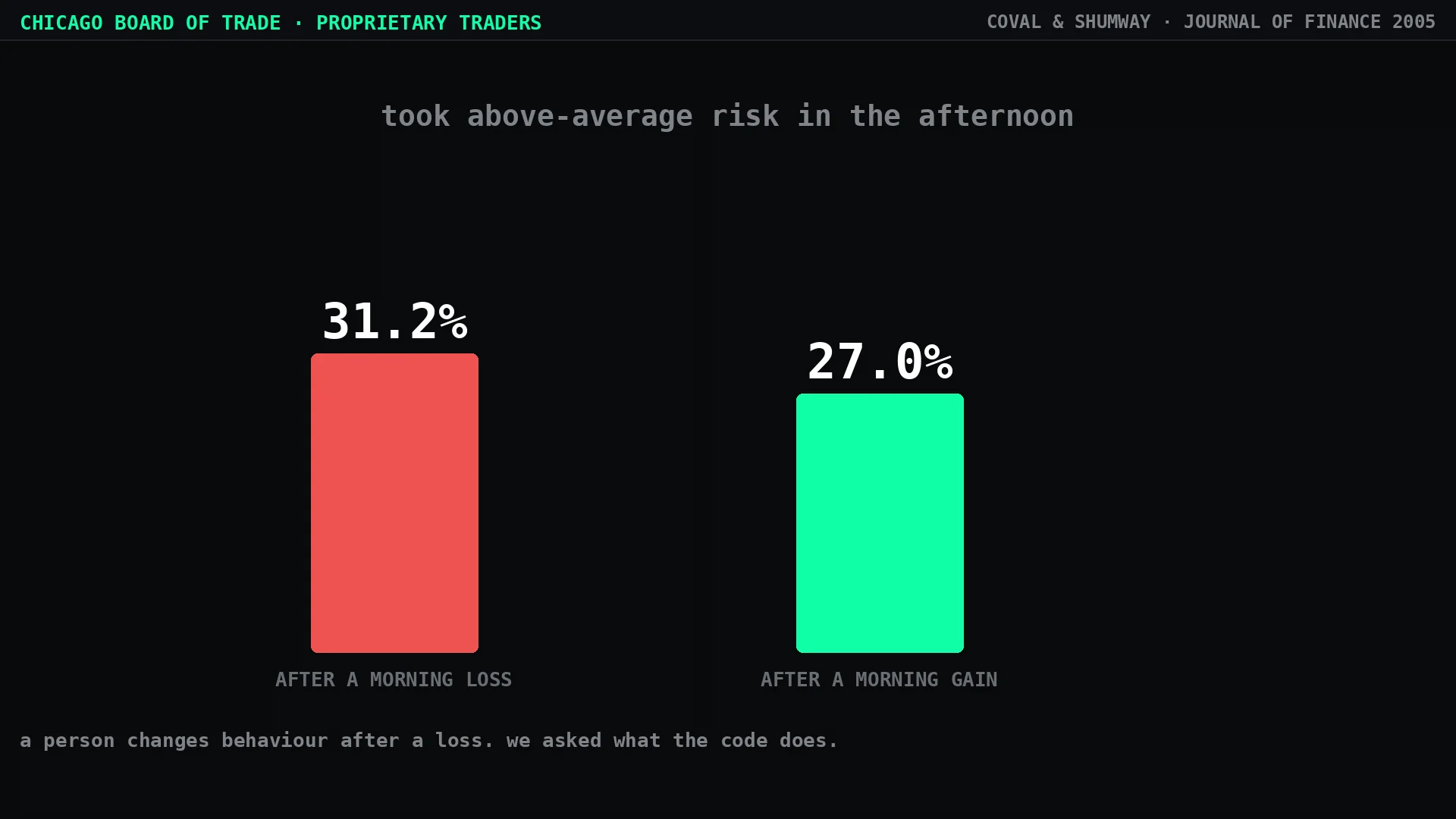
Professional traders took above-average risk after a losing morning 31.2% of the time, against 27% after a winning one. The effect is measured, not anecdotal.
Data layers: the trade record behind this test spans backtest to 31 March 2026 and live from 1 April 2026, on the same rule sets, at the stated account presets. The permutation test is run on that combined record; the layers are reported separately everywhere results are quoted on this site and are never blended into a single figure. Method at /methodology.
Most advice about revenge trading is anecdotal. Someone blew up an account, felt bad about it, and wrote a thread. That is useful as a warning and useless as evidence. There is, however, a proper study on the subject, and it is worth knowing about before you take your next trade after a stop-out.
The study
In 2005, Joshua Coval and Tyler Shumway published “Do Behavioral Biases Affect Prices?” in the Journal of Finance. The data came from proprietary traders at the Chicago Board of Trade — people trading their own capital in the pit, full-time, with years of experience behind them.
The authors split each trader’s day in two and asked a simple question: does what happened in the morning change what you do in the afternoon?
It does. Traders who were down on the morning took above-average risk in the afternoon 31.2% of the time. Traders who were up took above-average risk 27% of the time. They also traded more frequently and accumulated larger positions after a losing morning. The effect has been found again in other markets since, which means it is not a peculiarity of one exchange or one era.
What makes this different from the usual advice
Three things.
It measures behaviour rather than asking about it. Surveys of traders produce answers about what people believe they do; trade records produce what they actually did.
It uses professionals. The easy explanation for revenge trading is inexperience — that it is something beginners grow out of. These were full-time traders with their own money on the line, and the effect showed up anyway. That makes it less a question of discipline and more a question of how humans respond to a realised loss.
It is a small effect on an individual trade and a large one over a career. Four percentage points more often does not sound like much until you consider that it compounds over every losing morning in a trading lifetime.
Why it hits harder on a prop account
A personal account absorbs an oversized trade as a worse month. A funded account does not.
Prop accounts carry a daily loss limit and a drawdown floor. Take one extra trade at double size twenty minutes after a stop-out, and you are not trading a worse day — you are trading the account itself. The structural consequence of the behaviour is different even though the behaviour is identical.
This is also why the afternoon window from the study maps so badly onto funded trading. On the floor, an afternoon of elevated risk was a worse afternoon. On a funded account, it is often the end of the relationship.
What you can do about it
The finding suggests the fix is not more resolve. If professionals with decades of experience showed the effect, willpower applied in the moment is not the reliable control.
What works is moving the decision earlier. A rule written down before the session — position size, maximum trades per day, what happens after a stop-out — is a decision made by a version of you that has not just lost money. It is the same reason pilots use checklists in situations they have handled a hundred times.
We went a step further and tested whether our own rule-based systems show the effect at all, on 29 strategy versions: position size, win rate, and time to the next entry, before and after a loss. The full breakdown, with the method and the numbers, is here.
Reference
Coval, J.D. & Shumway, T. (2005). “Do Behavioral Biases Affect Prices?” The Journal of Finance, 60(1), 1–34.