Extreme reversion on a prop account: how Fade trades
It does not trade against a move because the move is large. It trades against a move only after the move itself has failed.
Data layers: modeled figures come from the trailing twelve months (Sep 2025 – Aug 2026) at the stated account preset · live figures are tracked separately since April 2026 · Monte Carlo: 1,500 paths × 3-year horizon. Layers are never blended.
Most reversal strategies fail on funded accounts for the same reason: they sell strength and buy weakness too early, and a trending market runs straight through the stop. Fade — the ninth family in our catalog, on the site since September 1st — is built around the opposite discipline. It does not trade against a move because the move is large. It trades against a move only after the move itself has failed.
Watch page with full transcript →
Exhaustion first, confirmation second, entry last
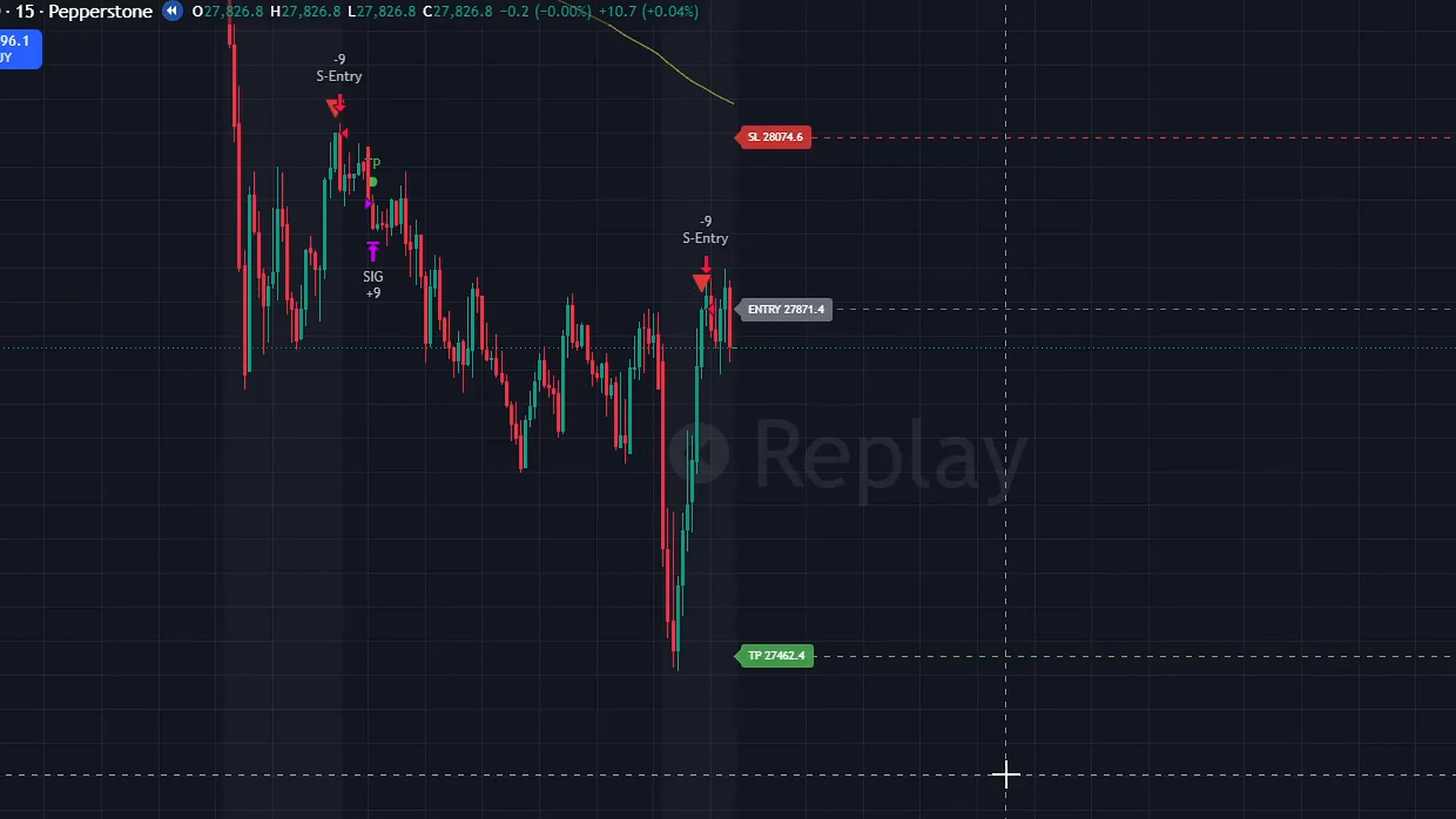
Fade waits for a directional push to stretch far beyond its normal range. That alone is not a signal. The strategy then requires evidence that the move has exhausted — that momentum has thinned and price has stopped making progress — and only after that confirmation does it position for the reversion, long and short alike. Conditions that are stretched but still trending are skipped entirely; the system stands aside rather than guessing the top.
The structure is deliberately simple: one timeframe on all four instruments, one position, one exit. The protective stop and the profit target are placed together with the entry, so there is nothing left to decide once the trade is on.
Four instruments, one calibration each
Fade runs on Nasdaq and gold as micro futures (MNQ, MGC) and as CFDs (NAS, XAU). What counts as “too far” is calibrated separately per instrument; the logic is shared, the thresholds are not. Position size comes from built-in account presets rather than manual input — 50K, 100K and 150K on the futures side, 100K and 200K on the CFD side, plus a custom quantity for anything else. The publication page and the Strategy Tester are public on TradingView.
The numbers, in two labeled layers
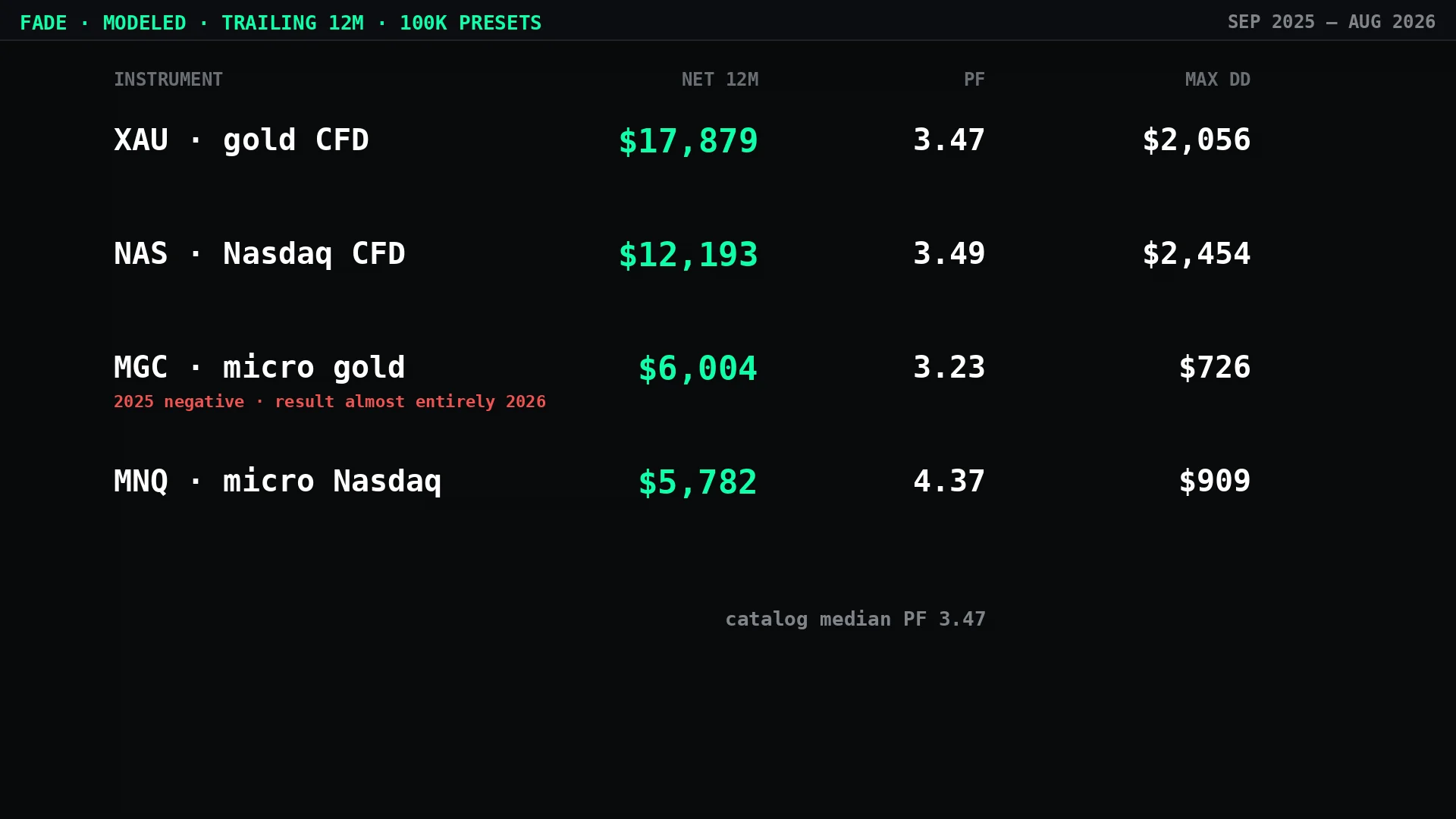
Modeled, trailing twelve months (September 2025 – August 2026), 100K presets: XAU +$17,879 · NAS +$12,193 · MGC +$6,004 · MNQ +$5,782. Profit factor between 3.2 and 4.4 on every instrument, above the catalog median of 3.47. Trade counts: 46 · 31 · 43 · 32 a year. MGC’s result carries a regime caveat — 2025 was negative and the figure is almost entirely 2026.
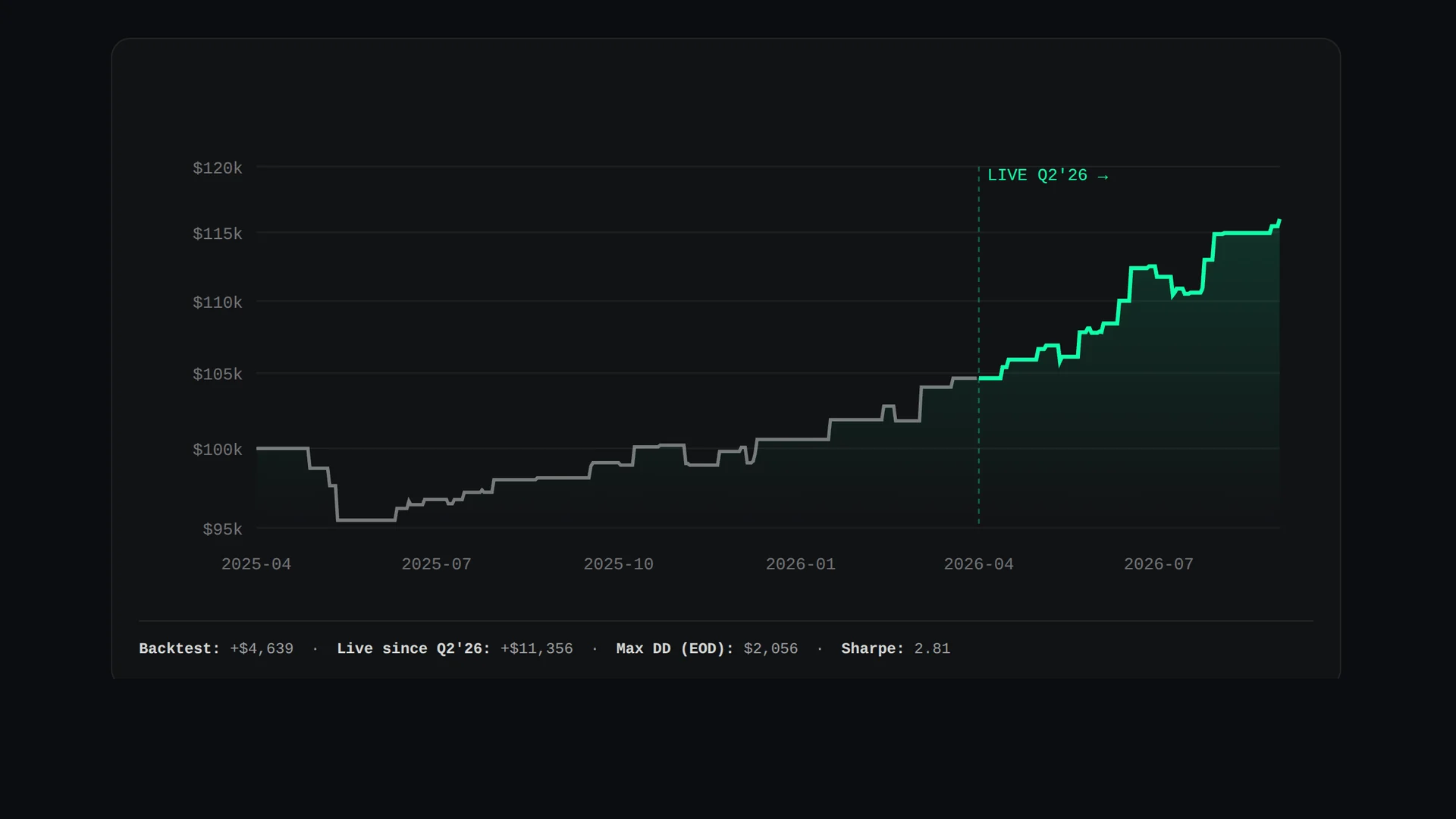
Live, separately: Fade has run on funded accounts since April 2026 — five months, 81 trades, +$31,006 net at 100K presets. The live layer is printed next to the modeled one on the strategy page, labeled, never blended.
The part that puts it at the top
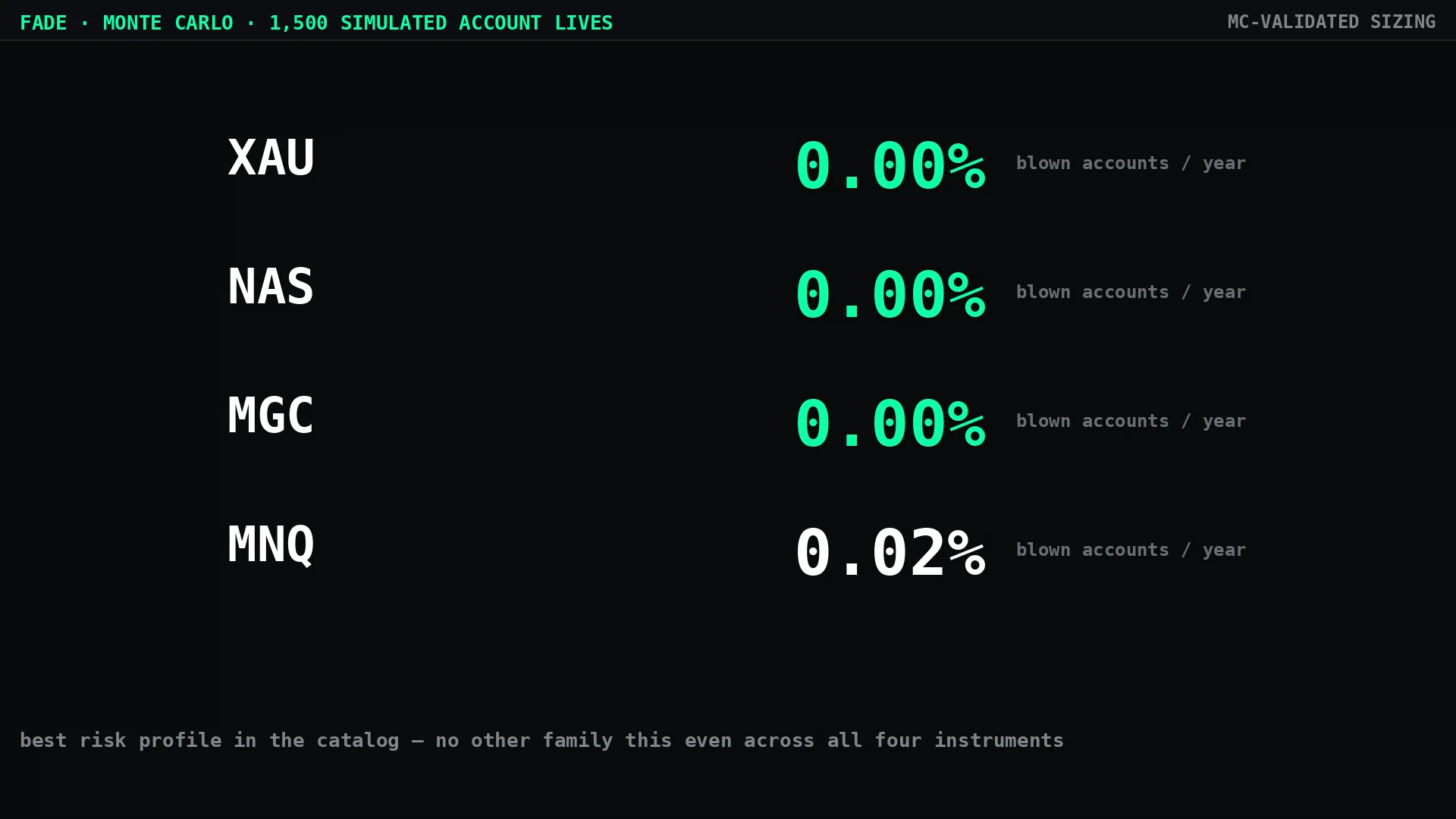
Across 1,500 simulated account lives (Monte Carlo, block bootstrap, full account lifecycle with payouts and drawdown floor), three of the four instruments blow zero accounts. The fourth blows two in ten thousand. The two lowest drawdowns among all our futures strategies — MGC at $726 and MNQ at $909, EOD basis at 100K — are both Fade. No other family in the catalog is this even across all four instruments.
The honest part
On the two futures instruments, a median simulated year (Monte Carlo P50, a separate layer from the trailing net above) is under $4,000 at the 100K preset; the catalog median is over $9,000. Fade takes thirty to forty-five trades a year — three or four a month. There will be quiet weeks.
So this is not an engine. It is a stabilizer: the strategy you add to a basket where something else is already working hard, to make the whole account calmer. It is not yet in any published portfolio; compositions are reviewed each quarter, and Fade is a candidate.
Access
Fade is included in every plan. Lifetime holders received it on September 1st automatically — no upgrade, no separate invoice. The publication page and tester are public on TradingView; the monthly tables, modeled and live, are on the strategy page.
The method, applied to the whole catalogue.
Every strategy and portfolio with modeled and live shown separately and the forecast behind each one. One PDF, then our letters with what the systems did.
By email, from Puerto Viejo, Costa Rica. Unsubscribe anytime.