Same Path, Run Twice: How We Measured What a Payout Does to a Funded Account
Comparing accounts that withdrew against accounts that didn’t tells you about selection, not about the payout.
Data layers: every figure here is modeled — a 1,500-path Monte Carlo (block bootstrap, three-year horizon, 25% trade dropout) over the twelve months of modeled data from September 2025 to August 2026. These are distributions across simulated paths, not results of any single account and not a forecast. Method at /methodology.
The claim in the main post is that a payout on a trailing-floor account raises the chance of a breach in the following two weeks by thirteen times. That’s a large number, and the obvious question is whether it measures the payout or measures something else. This is the method note on why it measures the payout.
The comparison that doesn’t work
The natural first attempt is to take all the simulated accounts, split them into those that withdrew and those that didn’t, and compare breach rates. It’s simple and it’s wrong.
Accounts that reach a payout are not a random sample. They’re the ones that were far enough above the floor to qualify, on the day they qualified. Accounts that haven’t withdrawn include everything else — paths that were struggling, paths that were early, paths that breached before ever getting there. Comparing the two groups tells you about the difference between accounts that were doing well and accounts that weren’t. The payout is mixed into that, but so is everything that led to it.
Any honest number about the transfer has to remove the selection.
The test that does
Every simulated path that reached its first payout was frozen at that moment and run forward twice from the same day.
In one branch, the payout is taken: the balance drops by the withdrawal, the floor stays where it is, position size stays tied to the account tier.
In the other branch, nothing is withdrawn: same balance, same floor, same size.
From that day onward both branches see exactly the same trades in exactly the same order. Same fills, same days, same sequence. The only thing that differs between them is the transfer.
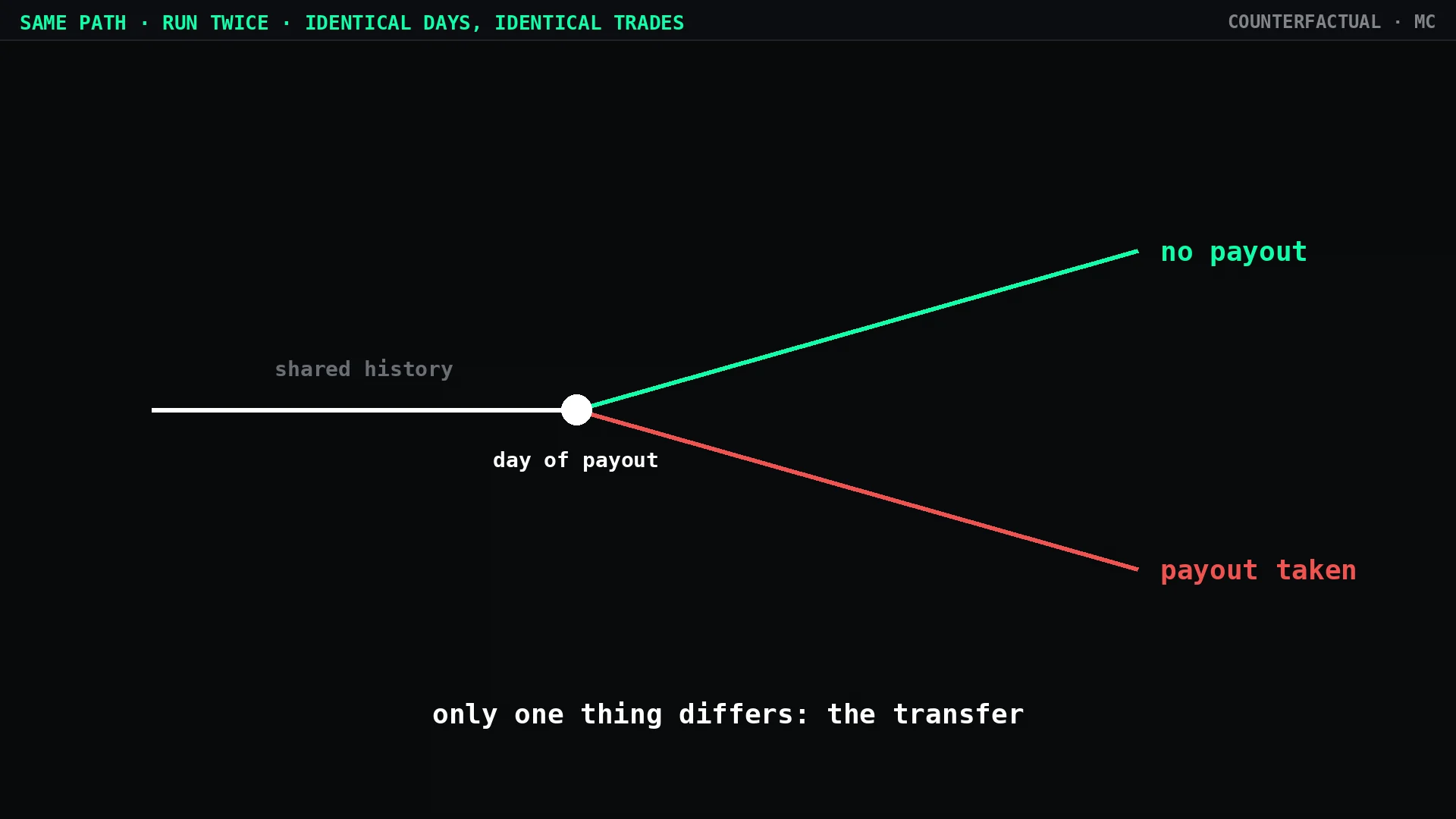
That’s what makes it a counterfactual rather than a comparison. Each account is its own control. Whatever a path was going to do over the next fourteen days, it does in both branches — and the branch that withdrew has less room to do it in.
What it showed
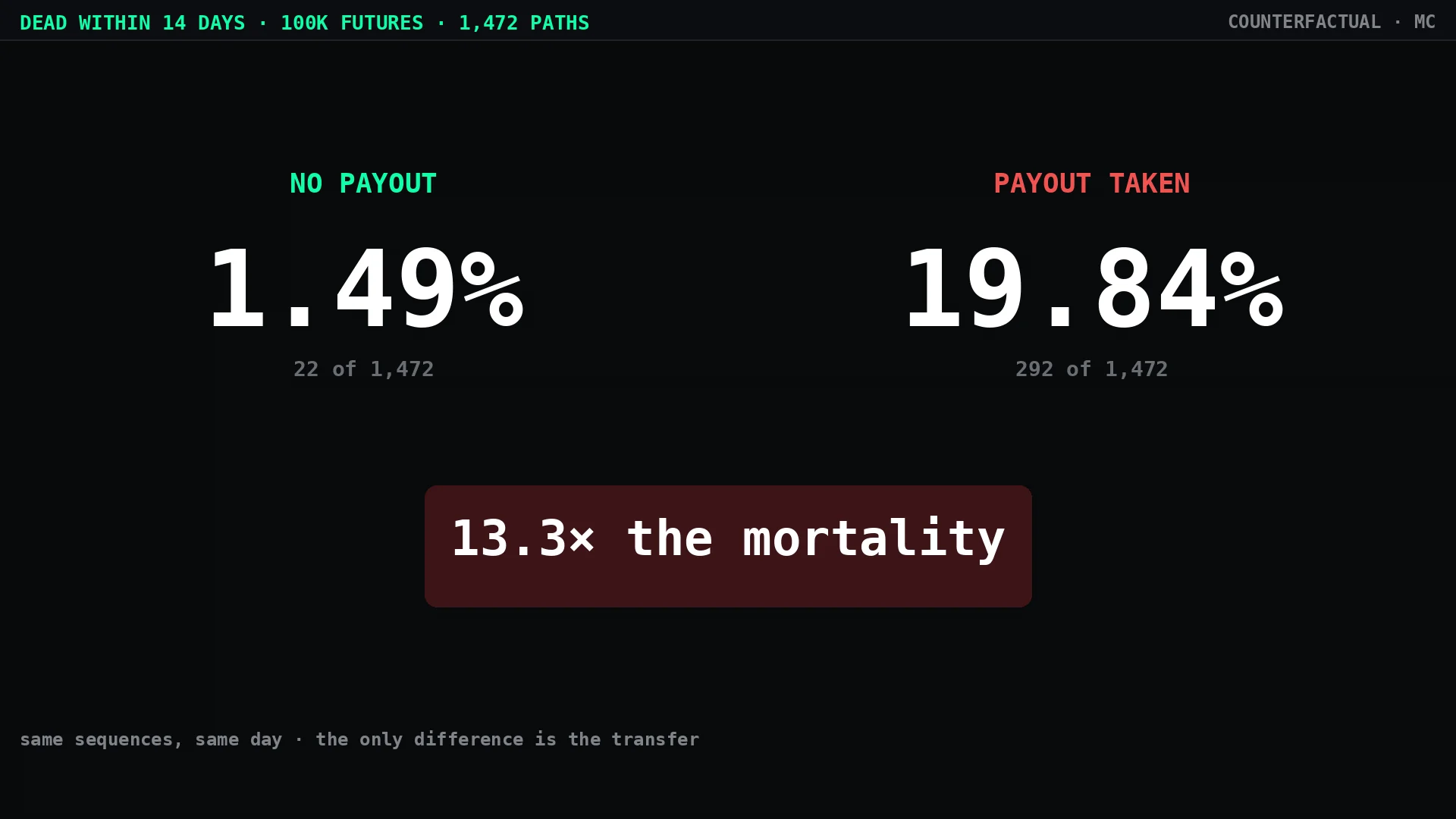
On the futures reference (100K Balanced 4X, EOD trailing floor, $3,000 buffer), 1,472 paths reached a first payout:
- no payout, same path: 22 breached within 14 days — 1.49%
- payout taken: 292 breached within 14 days — 19.84%
The difference, 18.3 percentage points, is the effect of the transfer with everything else held constant. Nothing about the strategy or the market changed between the branches. The stops landed on a buffer that had gone from $3,000 to $1,370, and a normal losing stretch that the full buffer absorbed became a breach.
On the forex reference, which runs a static floor with a balance reset, both branches show zero breaches. The method is the same; the account mechanic is what differs.
Why the method matters beyond this one number
Most claims about what causes accounts to fail are made from the first kind of comparison — traders who did X versus traders who didn’t. Those comparisons carry every difference between the two groups, and the thing being blamed is usually the most visible one rather than the operative one.
Running the same path twice with one variable changed is the cheapest way to separate a cause from a correlation in a simulated account. It doesn’t require more data. It requires the discipline to hold everything else fixed and change one thing.
The full setup — Monte Carlo parameters, block bootstrap, dropout — is on the methodology page. The consequences of the number, and what to watch after a withdrawal, are in the main post.
All figures are from a modeled Monte Carlo run and describe distributions across simulated paths, not results of any single account. Modeled results are not a forecast. Past performance does not guarantee future results. Not financial advice.