Why funded traders blow the account right after their first payout
Most people think a funded account dies during the grind. It doesn't. The grind is the safe part. The dangerous part starts the moment the first payout clears.
KEY FACTS
- (On forex swing accounts the floor mechanic works differently, but the behavioral half — house money and size creep — hits exactly the same.) 4.
- Trade #200 is sized exactly like trade #1.
- The system has no house-money state — trade #200 is sized exactly like trade #1.
Source: Puravida Edge, from the article below; rules data verified 29 September 2026.
I've watched this happen to dozens of traders, and to myself before I systematized everything. The pattern is almost boringly consistent. Someone passes the evaluation, trades clean for a few weeks, hits the profit threshold, requests their first payout, and feels the relief of finally being “in profit on someone else's money.” Then about a week or two later the account is gone. Not from a market crash. From them.
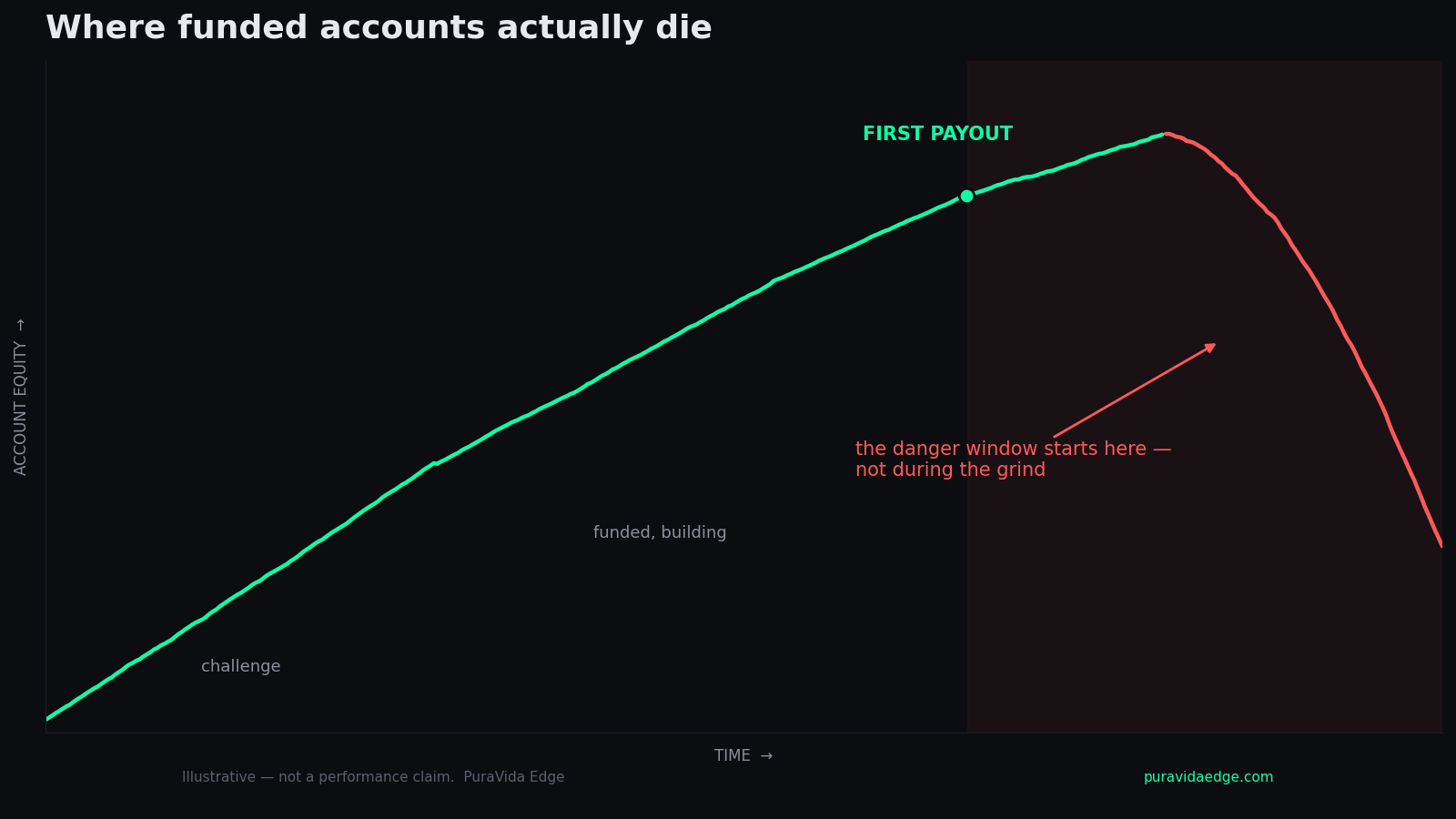
If you've blown a funded account before, look back at when it happened. For a lot of traders it wasn't the white-knuckle stretch trying to reach the target. It was right after the first win, in the window where they finally exhaled.
The pattern is predictable, which means it's structural
When something happens to this many different people at the same point in the lifecycle, it isn't a discipline problem unique to each person. It's structural. The structure of a funded account, plus normal human wiring, produces this outcome on its own. Four things stack up at the same time.
1. The house-money effect. Once the first payout clears, the account quietly gets reclassified in the trader's head. It stops being “my shot I can't afford to lose” and becomes “profit I'm playing with.” The downside feels softer because some money already came out. So risk loosens, not on purpose, just by feel.
2. Size creep after the win. Confidence after a payout is the most expensive feeling in trading. The trade that worked last week gets a little more size this week. Then a little more. The math nobody runs: a bigger position against the same drawdown budget means a single ordinary red day now breaches the account instead of just denting it.
3. The drawdown floor moved, and the old math is wrong. This one is specific to futures and almost nobody adjusts for it. On a trailing or end-of-day drawdown account, every new equity high ratchets the floor up. After a strong run into a payout, the floor is sitting much higher than where it started. The room you think you have left is your original drawdown limit. The room you actually have left is the distance between current equity and that elevated floor, which is usually far smaller.
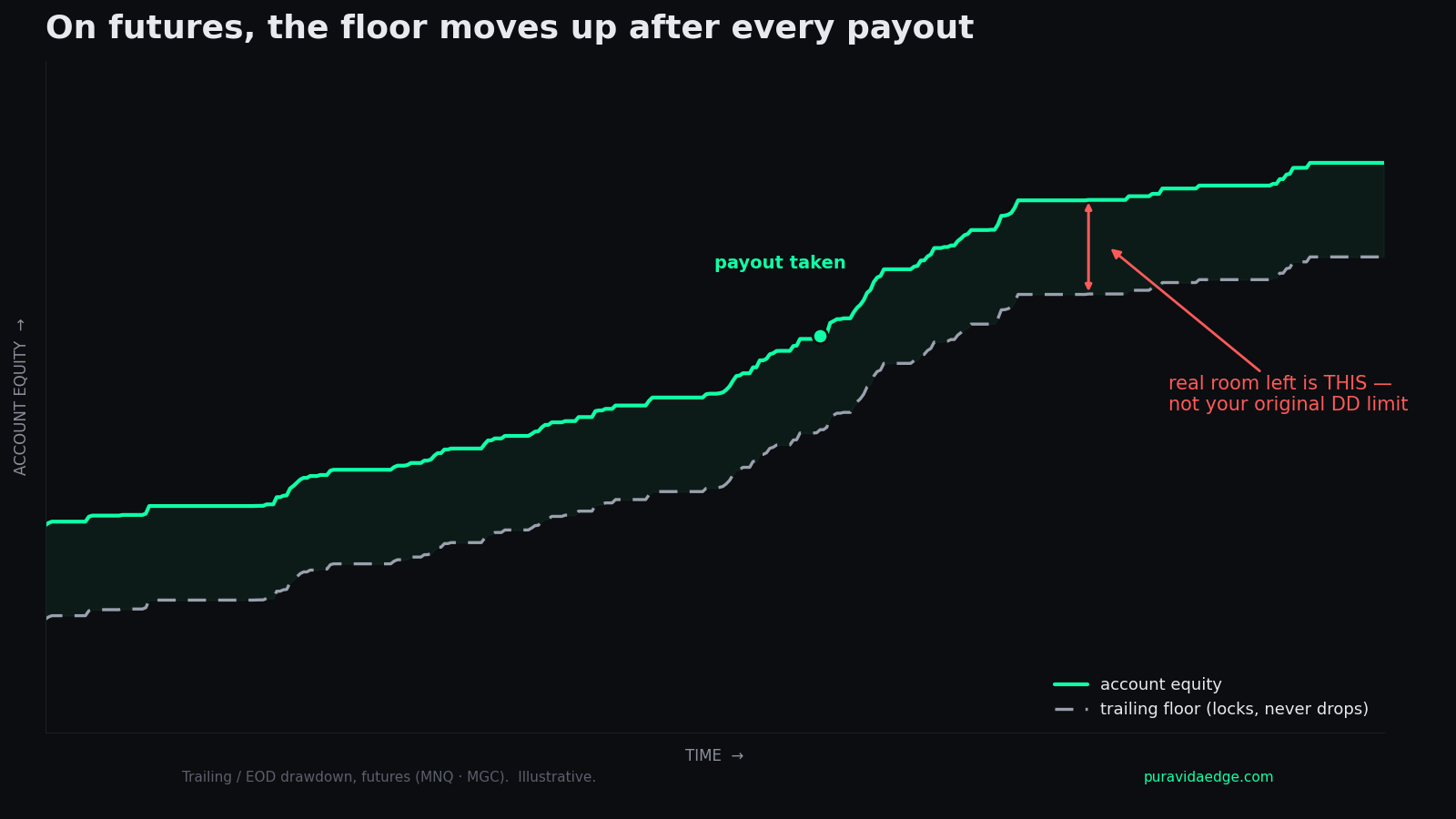
So the trader sizes off a number that is no longer real. They feel safe because the account is green and well above the starting balance. The floor is quietly two steps behind them, not the full limit they're picturing. One normal pullback closes that gap and the account is done. (On forex swing accounts the floor mechanic works differently, but the behavioral half — house money and size creep — hits exactly the same.)
4. Complacency. The discipline that carried someone to the first payout is the first thing they drop after it. Rules feel like training wheels once you've “made it.” The setups that were taken patiently start getting forced. A flat Tuesday afternoon, nothing on the chart, and a bored trader with house-money confidence is the exact recipe that ends a clean month by the close.
Why “just be more disciplined” doesn't fix it
The standard advice for this is some version of stay humble, manage your risk, don't get cocky. It's not wrong. It's just useless, because it asks the part of you that's most compromised — your judgment right after a win — to police itself.
Every decision made under that house-money feeling is a coin flip. Size up or hold? Take this marginal setup or skip it? Move the stop or leave it? You can win those coin flips for a while. Across enough decisions, the variance catches you, and it catches you hardest in the window where you're least careful. You can't beat statistics with intuition, and the post-payout window is where intuition is at its worst.
The structural answer: remove the decision, not the emotion
You can't talk yourself out of the house-money effect. What you can do is build a system where the dangerous decisions don't exist to be made.
This is the whole reason I stopped trading discretionarily and hardcoded everything. Three things change when sizing and execution are fixed in advance:
The position size never reacts to the last result. It's pre-sized against the firm's drawdown limit before the first trade and it does not move because you just got paid. The decision “should I size up now that I'm in profit” is not a decision the system can make. Trade #200 is sized exactly like trade #1.
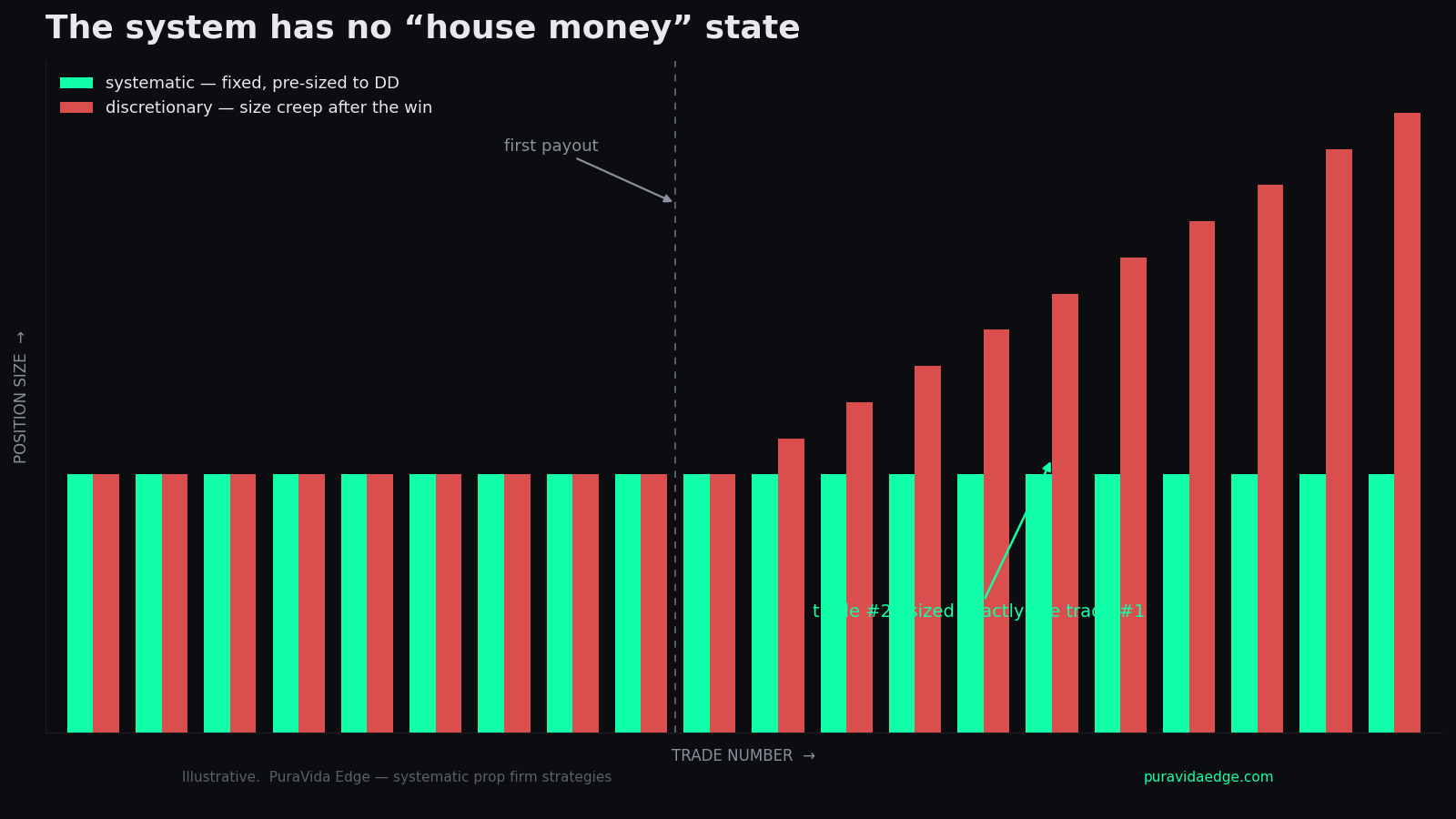
There is no house-money state. The rules don't know or care that a payout happened. Behavior doesn't depend on the previous outcome, the account balance, or how the trader feels that morning. The thing that makes humans dangerous after a win — memory of the win — simply isn't an input.
It's sized for the worst-case floor, not the comfortable one. On futures (MNQ, MGC), the position is pre-sized against where the trailing floor actually sits, and an end-of-day guard makes sure nothing is left open into the close to surprise you. On forex (NAS, XAU), the same protection comes from hardcoded take-profit and stop levels working inside a fixed drawdown budget, sized for swing exposure rather than a session close. Either way, the sizing assumes the floor that exists, not the limit you wish you still had.
The net effect is that the single most dangerous moment on a funded account — the stretch right after your first win — becomes a non-event. Nothing about the system speeds up, loosens, or gets brave. It takes the trades it was always going to take, skips the ones it wasn't, and stays the same size whether you're up a payout or flat on the month.
What actually happens to the account, the pending payout and the other accounts after a breach is in what happens when you blow a funded account.
The takeaway
If you've blown funded accounts, it's worth being honest about where it actually happened. If it keeps happening right after the first payout, the problem isn't your discipline and it isn't your setup. It's that a funded account asks for your best judgment at the exact moment your judgment is worst, and human traders lose that trade over a long enough run.
The fix isn't more willpower applied to the same broken structure. It's a structure that doesn't ask for willpower at the dangerous moment at all.
Watch page with full transcript →
See every prop firm rule, grouped by mechanism →
10 strategies, 15 portfolios, one PDF.
Every result on this site, modeled and live separately, with the preset for each account tier. One PDF, then our letters with what the systems did.
By email, from Puerto Viejo, Costa Rica. Unsubscribe anytime.
Related
- What 12,000 backtests reveal about prop firm payouts
- Fastest path to your first prop firm payout
- Two 100K accounts, opposite payout profiles
FAQ
When are funded accounts most likely to blow?
Often in the one to two weeks right after the first payout, not during the run-up to it. House-money confidence, position size creep, and a trailing drawdown floor that has quietly moved higher all stack up at the same time.
Why does a trailing drawdown floor make this worse on futures?
On a trailing or end-of-day drawdown account, every equity high ratchets the floor up. After a strong run into a payout, the real distance to the floor is much smaller than your original drawdown limit, so traders size off a number that is no longer accurate.
Does this affect forex prop accounts the same way?
The behavioral half (house money, size creep) is identical. The floor mechanic differs because forex swing accounts aren't session-flat the way futures are, so the protection comes from fixed take-profit and stop levels inside a set drawdown budget instead.
Can discipline alone fix the post-payout blow-up?
Rarely, because the problem is that judgment is most compromised exactly when the account is most exposed. Removing the discretionary decisions (fixed pre-sized rules that don't react to the last result) is more reliable than asking yourself to stay disciplined at the worst possible moment.
Not financial advice. Performance characteristics referenced are hypothetical, modeled outputs (backtested and Monte Carlo–simulated). Past performance does not guarantee future results. Prop-firm Terms of Service compliance is your responsibility — verify every rule with the firm directly.
Firm rules verified September 2026. Prop firm rules change frequently; confirm on the firm's site before purchasing an evaluation.