Intraday trailing drawdown
Also called intraday drawdown or real-time trailing drawdown. Intraday trailing drawdown is a trailing loss limit whose floor follows the account's highest equity touched at any moment during the session, including unrealised profit.
KEY FACTS
- As of September 2026 (11 of 40 firms on our rules cards), the firms below run an intraday (real-time) trailing floor on at least one account type.
- For amounts and lock rules see EOD vs intraday trailing, firm by firm ; the full matrix is on the 40-firm comparison table .
- What an intraday trailing drawdown actually tracks Section merged from the former standalone article on 8 October 2026; figures as verified at that date.
- One worked example Take an account with a $3,000 drawdown limit, at its high.
Source: Puravida Edge, from the article below; rules data verified 29 September 2026.
How it works
Every tick of unrealised gain raises the high-water mark, and the floor follows it. A trade that runs into profit and then retraces moves the floor up on the way out and leaves it there on the way back. The result is that a position can breach the account without a single losing trade ever being closed — the loss is measured against profit that existed only on screen.
Why it matters on a funded account
This is the strictest common model and the one that punishes scale-out exits and wide targets hardest. A strategy that lets winners run accumulates floor movement it never banks. On an intraday account the practical constraint is not the stop distance but the maximum favourable excursion the strategy tolerates before taking something off.
Which prop firms use an intraday trailing drawdown?
As of September 2026 (11 of 40 firms on our rules cards), the firms below run an intraday (real-time) trailing floor on at least one account type. Where the evaluation and the funded stage differ, both are listed; the firm’s rules card has the exact amounts.
| Firm | Type | Evaluation drawdown | Funded drawdown |
|---|---|---|---|
| Apex Trader Funding | futures | EOD or intraday (separate products) | Same as purchased |
| MyFundedFutures | futures | EOD (Pro, Builder, Rapid, Rapid EOD); legacy Flex static | EOD locks at +$100; standard Rapid intraday until locked |
| Lucid Trading | futures | EOD (Pro/Flex/Direct) | EOD (Pro, Flex, Direct); intraday (Daily) |
| Take Profit Trader | futures | EOD trailing (Test) | Intraday (PRO); EOD (PRO+) |
| TradeDay | futures | Trailing: intraday or EOD (Quick Pay), EOD (Fast Pass) | Same; fixed at starting balance from first payout |
| FundingPips | forex | Static 6–12% by program; Zero 5% intraday trail | Same as evaluation |
| Bulenox | futures | Option 1 intraday trailing; Option 2 EOD + DLL | Same as purchased; locks at start + $100 |
| Top One Futures | futures | EOD trailing (all current programs); S2F legacy intraday | Closing balance or EOD by program |
| Funded Futures Family | futures | EOD (Prime, S2F); EOD or intraday (Premier+); intraday (Velocity) | EOD (Prime, Premier+, S2F Standard); intraday (Velocity) |
| E8 Markets | cfd | Dynamic: intraday trailing (E8 One/Classic/Track), EOD (Signature); 4% to 14% customizable | Same; E8 One widens 1% per payout to 14%; Signature turns static at buffer |
| OneUp Trader | futures | Real-time trailing, locks at starting balance | Partner-governed |
The remaining 29 firms use end-of-day trailing or static drawdown on every account: Topstep, Tradeify, Alpha Futures, FTMO, Phidias, FundedNext Futures, Maven Trading, FundedNext (CFD), The5ers, Alpha Capital Group, Blue Guardian, GOAT Funded Trader, BrightFunded, Funded Trading Plus, FXIFY, Instant Funding, FunderPro, The Trading Pit, City Traders Imperium, TX3 Funding (ex-TopTier), Funded Trader Markets, Ment Funding, PipFarm, FTUK, Earn2Trade, Leeloo Trading, Elite Trader Funding, TickTick Trader, UProfit. For amounts and lock rules see EOD vs intraday trailing, firm by firm; the full matrix is on the 40-firm comparison table.
What an intraday trailing drawdown actually tracks
Section merged from the former standalone article on 8 October 2026; figures as verified at that date.
Most traders read a drawdown rule once, when they buy the account, and then trade against their memory of it. With an intraday trailing floor, that memory is usually wrong in one specific way: people think it tracks their results. It tracks their peaks.
Three models in three sentences
A static drawdown floor sits at a fixed level below your starting balance and never moves.
An end-of-day trailing floor follows your balance upward, but only using the closing value of each trading day.
An intraday trailing floor follows your equity upward in real time, including profit on positions that are still open.
The difference between the last two sounds technical. In practice it decides whether a flat day costs you anything.
One worked example
Take an account with a $3,000 drawdown limit, at its high. You open a position. It moves in your favour and shows $1,500 of unrealized profit. Then it reverses and you close it at break-even.
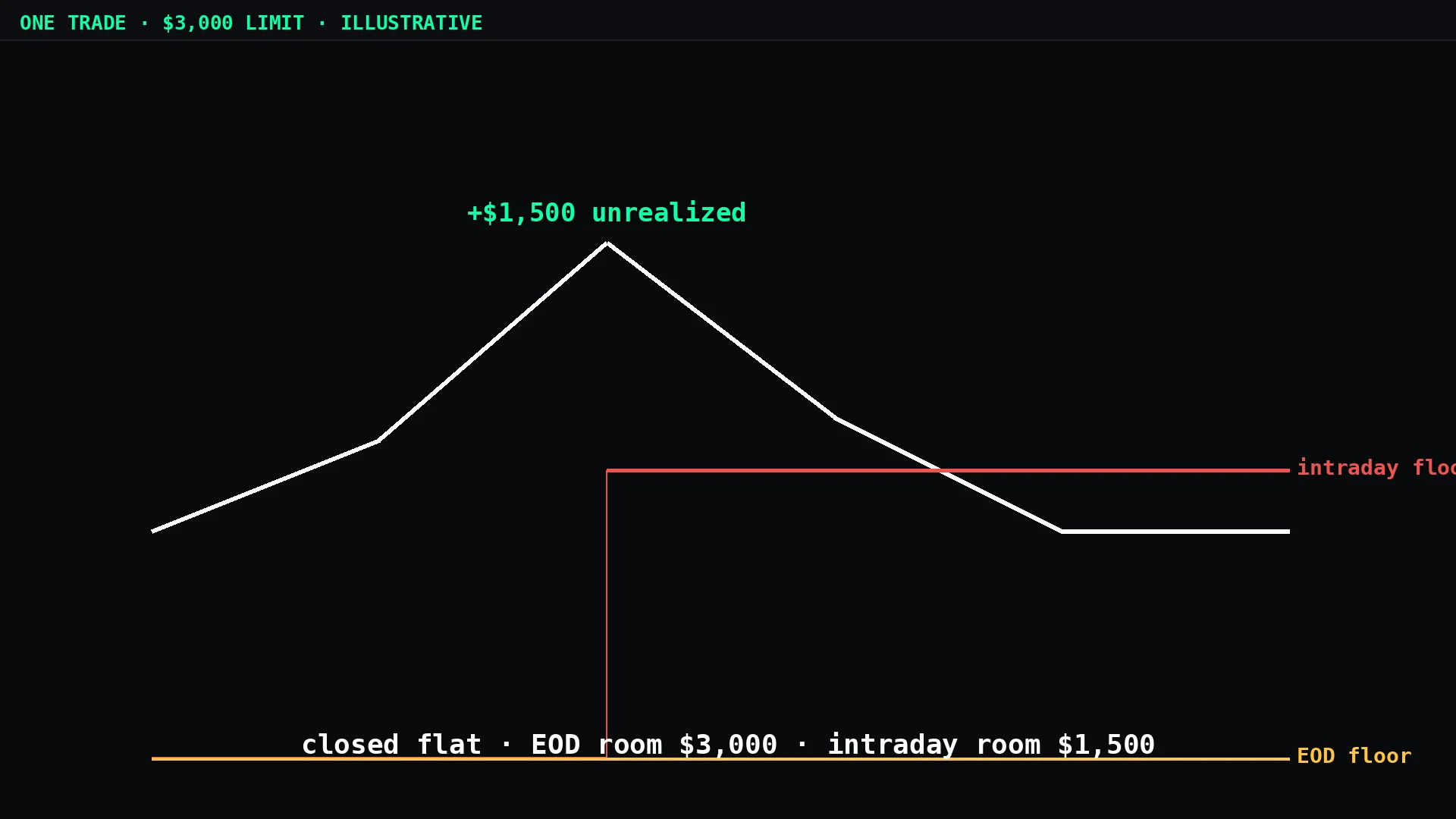
On an end-of-day floor, nothing happened. The day closed flat, the closing balance set no new high, the floor did not move. You still have $3,000 of room.
On an intraday floor, the floor rose $1,500 when the position peaked. It does not come back down when the position does. You closed flat, and you now have $1,500 of room.
Nothing about your close matters here. The floor had already moved before you closed.
Why this catches experienced traders
Two habits that are sensible on other account types become expensive on intraday trailing.
Letting winners run is the first. A position that runs far and then retraces to a modest gain raises the floor by the full run and banks only the modest gain. The better the trade looked at its best, the more room it cost.
Reading the daily P&L is the second. On an intraday account, the day can end green and the account can still be finished, because the level that ended it was touched between the peak and the close. That event never shows up in an end-of-day statement.
Two questions before you buy the account
Which floor model does it use? It is usually one line in the rules, and it matters more than the price.
If it is intraday, how much does your strategy give back before it exits? Your trade history has the answer: for each trade, subtract what you actually made from the maximum open profit you had. On an intraday floor, your real risk per trade is your stop plus that number.
We ran the same question across a full portfolio and 1,500 simulated account lives — the complete breakdown, with one real trade and the survival numbers for all three models, is here. To see the three floors move on the same path, use the trailing drawdown visualizer.
FAQ
What is intraday drawdown?
Another name for the intraday trailing drawdown: a loss floor that follows the highest equity your account touches during the session, open profit included, and never moves down. It differs from end-of-day trailing, which moves once from the closing balance, and from a daily loss limit, which resets each day.
Read next
Part of the Puravida Edge prop trading glossary. Firm-specific figures verified September 2026; rules change frequently — confirm on the firm's site.
10 strategies, 15 portfolios, one PDF.
Every result on this site, modeled and live separately, with the preset for each account tier. One PDF, then our letters with what the systems did.
By email, from Puerto Viejo, Costa Rica. Unsubscribe anytime.