Zone: the triple-zone pullback strategy, now on the book
Zone is the newest family in the lineup: a pullback-continuation system that only trades where several independent context layers point at the same price area. July 2026 was its first live month.
Mixed layers. July figures are live results at 100K presets, after commission and slippage. Position sizing is modeled (1,500-path Monte Carlo). The backtest sample is deliberately small — Zone takes few trades by design.
Zone is the newest strategy family in the Puravida Edge lineup: a pullback-continuation system that only trades where several independent context layers point at the same price area, on a 7-minute timeframe across MNQ, MGC, NAS and XAU. It takes deliberately few trades — typically a few per month per instrument — and every position is fully pre-defined before entry. July 2026 was its first month running live, and the numbers below say why it earned a permanent slot.
What does Zone actually trade?
Most pullback systems react to a single condition: price touches a level, an indicator crosses, a candle closes a certain way. Zone works the other way around. It waits for price to return into an area where several independent layers of context overlap, and then requires the reaction itself to confirm before committing. If the full set of conditions isn't there, the setup is skipped entirely — no partial credit, no discretionary override.
That selectivity is the design, not a side effect. The trade count stays low on purpose, which also means the published sample is smaller than usual for this timeframe: fewer trades per month, each one carrying the full weight of the confluence requirement.
How is the risk handled?
Every position carries a protective stop and a defined target from the moment it opens. On the CFD instruments (NAS, XAU) the stop and target are attached to the entry command itself, so the position is protected on the broker side even if the alert chain fails afterwards. On the futures instruments (MNQ, MGC) the exits are managed by the platform and fire their own alerts, with an optional end-of-day guard that flattens ahead of the session close for accounts that require it.
Position sizing follows the same standard as the rest of the lineup: account-tier presets (50K/100K/150K futures, 100K/200K CFD) with quantities derived from Monte Carlo block-bootstrap simulation with drawdown gates — sized against funded-account risk limits, not maximum return. That's the modeled layer, and it's the reason a low-frequency strategy can sit inside a portfolio without dominating its drawdown budget. If you want to see how that kind of sizing math works on your own numbers, the Monte Carlo simulator runs the same class of simulation.
How did the first live month go?
July 2026, live, at 100K presets, after commission and slippage: Zone finished at +$11,598 — the second-best result of all eight families on the book that month — and closed green on all four instruments. For context, three established families finished July in the red, and the month still ended at +$27K across the lineup; Zone was one of the two families that carried it.
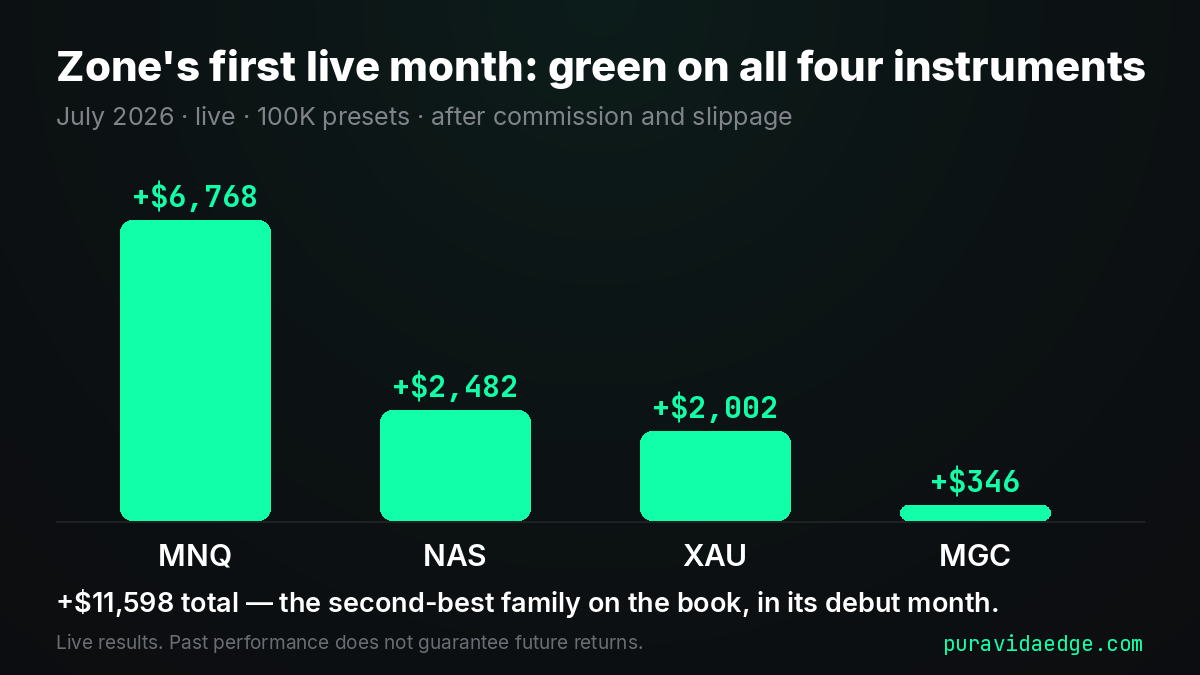
One month is one month. We're not extrapolating a debut into a track record, and the strategy's low trade count means its monthly results will swing more than a high-frequency system's. What the debut does show is the reason Zone was added: a return profile that doesn't lean on the same conditions as the families that went quiet in July. The full month, family by family, is in the July results breakdown.
Where does it fit in a portfolio?
Zone's job is exactly what July demonstrated — paying in months where other mechanisms don't. Its confluence-and-pullback logic goes quiet in different conditions than the breakout- and open-driven families, which is the property that matters when several strategies share one drawdown limit. The full logic of pairing strategies against a single account buffer is covered in which prop firm rules can a systematic strategy actually pass, and the strategy's own page has the complete specification, chart and current figures: Zone.
Like every strategy in the lineup, Zone ships as an invite-only TradingView script: one script, four instruments, instrument-specific access keys, alerts pre-built for automated routing — MT5 commands for CFD, JSON payloads for futures — with position size embedded in every alert.
July figures are live results at 100K presets, after commission and slippage; results at other tiers scale with preset quantities and are not “your results”. Sizing derivation is modeled (Monte Carlo). Past performance and backtested results do not guarantee future returns. Trading futures and CFDs carries substantial risk of loss. Not financial advice.
Want the full picture, including the actual payout proof and how it's validated? It's in the playbook for prop traders.
Get the Playbook →Not financial advice. Performance figures across this site are a combination of live-tracked and modeled results. Past performance does not guarantee future results.