The prop firm consistency rule, explained (2026)
The consistency rule is the reason traders pass an evaluation and then cannot withdraw. It has nothing to do with your win rate or your drawdown. It measures one thing: how much of your total profit came from your single best day.
The formula is the same almost everywhere:
largest single-day profit ÷ total profit = consistency % (the consistency rule calculator runs it for 24 firm presets)
If the firm sets 50%, your best day must stay under half of everything you made. Miss it and the payout button does not appear. On most firms this does not fail the account — you simply keep trading until the ratio evens out.
Consistency rules by firm
The percentages differ, but the bigger difference is when the rule applies. A rule that only exists during the evaluation is far cheaper than one that gates every withdrawal for the life of the account.
Thresholds on our cards, September 2026, grouped by stage:
- None in the evaluation, checked at payout: Apex 50% on Performance Accounts (30% on pre-March-2026 legacy), LucidPro about 40% per cycle, Bulenox 40% on every Master Account payout, Alpha Futures Zero 40% between requests, Phidias 30% on funded Cash accounts, Tradeify Growth 35%, Maven 20% on Instant and funded accounts.
- Evaluation only, none once funded: Topstep 50% (Combine), Take Profit Trader 50% (Test), MyFundedFutures Rapid and Pro 50%, TradeDay Quick Pay 30%, Earn2Trade 30%, Tradeify Select 40%, LucidFlex and LucidDaily 50%, FundedNext Futures Flex 40%.
- Instant and direct accounts: 15–25% at payout at most firms (LucidDirect, Alpha Direct, Maven Instant, Top One Instant, FundingPips Zero); Funded Trading Plus Instant runs 50%.
- None at any stage: FTMO, BrightFunded, The5ers, Ment Funding, FunderPro Classic, Alpha Capital Group (Bi-Weekly path), Blue Guardian (standard models).
The full 40-firm table with plan-level thresholds, notes and sources is on prop firms without a consistency rule; this page stays with the mechanics.
Apex has two live rules at once — check which one you bought
This trips up more people than any other single detail in 2026. On 1 March 2026 Apex replaced the old 30% consistency rule with a clearer 50% rule, as part of the same update that removed the MAE rule and the 5:1 risk-reward restriction. But the change applied to new account purchases only. An account bought in February 2026 still runs the 30% rule today.
What that difference costs in practice: say your best day since the last payout was $1,800 and your total profit is $3,200.
Under 50% you need $1,800 ÷ 0.5 = $3,600 total. You are $400 away — a few ordinary days.
Under 30% you need $1,800 ÷ 0.3 = $6,000 total. You are $2,800 away, and no future day may exceed $1,800 either. At $120 a day that is roughly another month of trading before the payout unlocks.
Same trading, same account size, twenty percentage points apart.
Firm-by-firm thresholds, including TradeDay’s two plans, Take Profit Trader and Alpha Futures, are on prop firms without a consistency rule: 40 firms by plan.
How much can one day earn?
Invert the formula and it becomes a planning number rather than a surprise. Your best day may earn at most total profit × threshold.
| Total profit since last payout | Cap at 50% | Cap at 40% | Cap at 30% | Cap at 20% |
|---|---|---|---|---|
| $1,000 | $500 | $400 | $300 | $200 |
| $2,000 | $1,000 | $800 | $600 | $400 |
| $3,000 | $1,500 | $1,200 | $900 | $600 |
| $5,000 | $2,500 | $2,000 | $1,500 | $1,000 |
| $10,000 | $5,000 | $4,000 | $3,000 | $2,000 |
Source: Puravida Edge rules cards, 40 futures and CFD prop firms, verified 29 September 2026.
Read it the other way for evaluations: on a 50K account with a $3,000 target and a 50% rule, a single $1,500 day puts you exactly on the line the moment you reach target. One cent more and the day you pass is the day you fail.
Why systematic traders trip on it — and why they also fix it easily
A discretionary trader gets a big day by pressing when conviction is high. That is precisely the profile the rule punishes. The irony is that the same trader cannot reliably repeat the big day, so the ratio stays broken for weeks.
A rules-based strategy has the opposite problem and the opposite fix. Position size is fixed in advance, so daily P&L clusters instead of spiking — which is what the rule rewards. Where it still bites is the outlier session: a strong trend day where every signal works. Two practical controls:
Cap the day, not the trade. Decide before the session what a single day may contribute, and stop taking new entries once that number is hit. This costs you the tail of one good day and buys the payout.
Sequence the evaluation. If the rule applies in the eval, a slower pass with even days is worth more than a fast pass you cannot withdraw from. Spreading the same target across more days lowers the ratio mechanically.
This is also why per-account sizing matters more than strategy selection. Our portfolio configurations are sized against the drawdown limit for each account tier rather than a return target — which produces the flatter daily distribution that consistency rules are built to reward. The arithmetic is in sizing off the drawdown limit.
What it is not
Consistency is not the daily loss limit, and it is not the drawdown. The daily loss limit caps how much you can lose in a session; consistency caps how much of your profit one day may represent. Breaching a daily loss limit can end an account. Breaking consistency, on almost every firm in the table, only delays a withdrawal. Full taxonomy of the drawdown types is in trailing vs static vs daily-loss drawdown.
Rather than working the ratio out by hand each time, the consistency rule calculator takes your best day and total profit and tells you whether the payout clears.
The cap is one filter among several, and which strategies clear it comes down to the shape of their daily P&L rather than their discipline — we map every major rule to the strategy number it reads in which prop firm rules a systematic strategy can actually pass.
See every prop firm rule, grouped by mechanism →
Why traders fail the consistency rule: your best day can fail the evaluation
Section merged from the former standalone article on 8 October 2026; figures as verified at that date.
You hit the profit target. The evaluation says no. Not because of a bad day, but because of a good one. That is the consistency rule, and it catches people precisely when they think the hard part is over.
The rule in 100 seconds — watch page with full transcript.
What the rule actually checks
A consistency rule caps the share of your total profit that can come from a single day: best day ÷ total profit must stay at or below the threshold, checked when you pass or request a payout. Thresholds and phases by firm are in the consistency rule explained. It doesn’t punish your worst day. It punishes your best one.
The arithmetic you actually need
Rearrange the rule and you get the only number that matters in practice:
required total profit = best day ÷ threshold
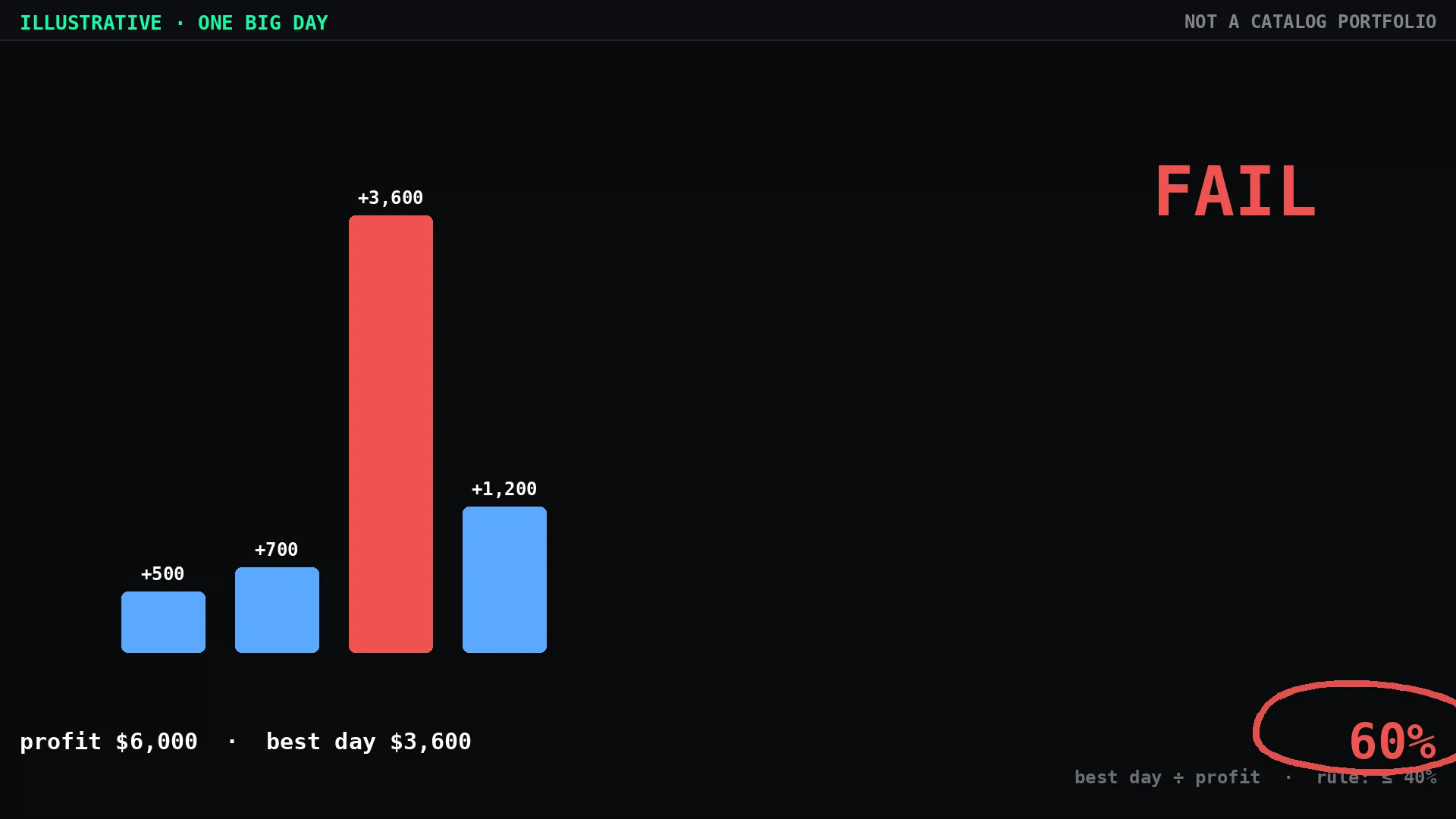
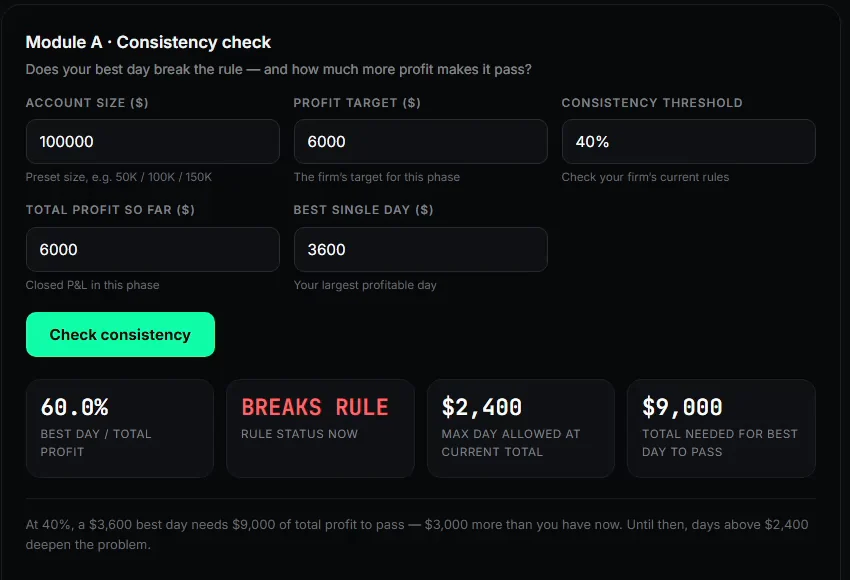
Take an illustrative account with a $6,000 target. The target is hit in four days, but one of those days made $3,600, which is 60% of the profit. Under a 40% threshold that fails. The total needed for that best day to pass is $3,600 ÷ 0.40 = $9,000, so the account needs another $3,000 of profit before it qualifies.
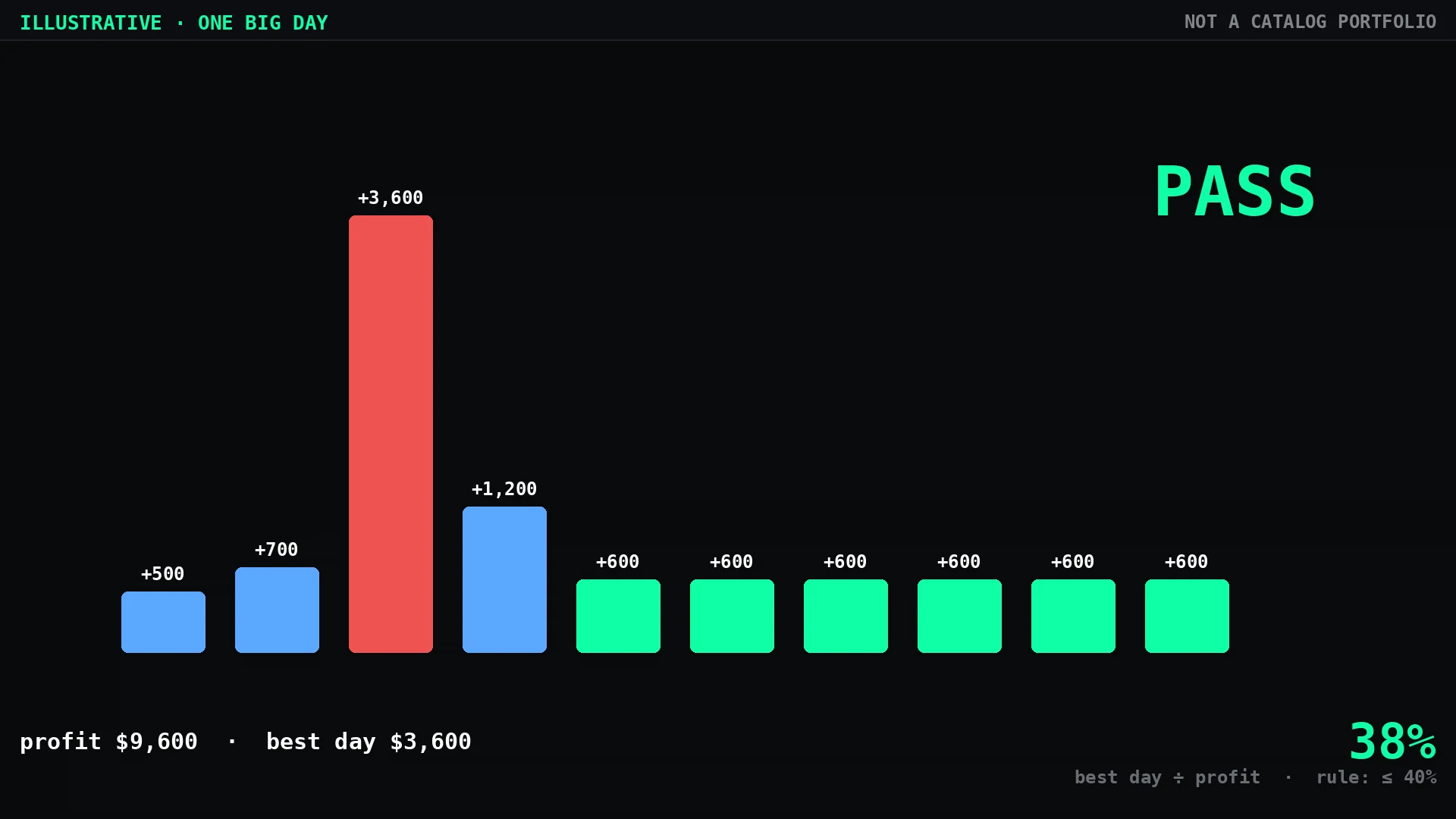
Add a few ordinary days and the share comes down. At $9,600 of total profit, the same $3,600 day is 38% and the account passes.
You can run this for your own numbers in the consistency rule calculator: account size, target, threshold, total profit so far and best single day.
Two versions of the same rule
This is the part that decides whether the rule is a nuisance or a wall.
Under a strict reading, the check happens at the moment you hit the target. If your best day is above the threshold then, the evaluation fails.
Under a keep-trading reading, hitting the target with a large best day doesn’t end anything. You keep trading normally until the share of your best day falls under the threshold, and then you pass.
Same division, very different consequence. Before anything else, find out which one your account uses.
What a portfolio that never runs into it looks like
Here is 100K-Growth between March 3 and March 30, 2026. Twenty-eight days, ten winning days, no losing days, and not one day above $1,000. The best day was $999 out of $6,918 of profit: 14%.
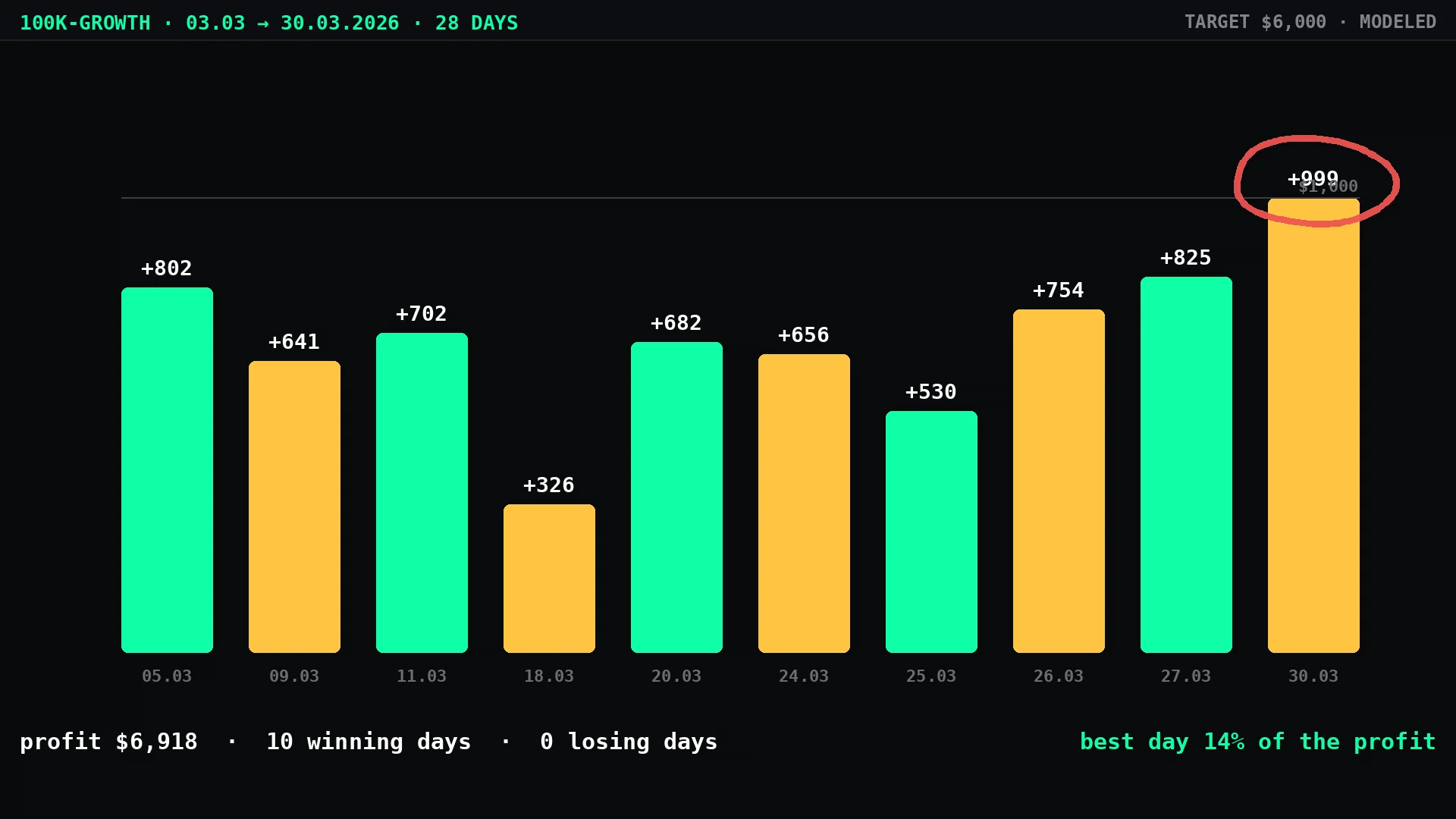
That profile passes any common threshold without trying, strict or not. Nothing about the trading changed to accommodate the rule; the shape of the profit simply never concentrates on one day.
The keep-trading rule in numbers
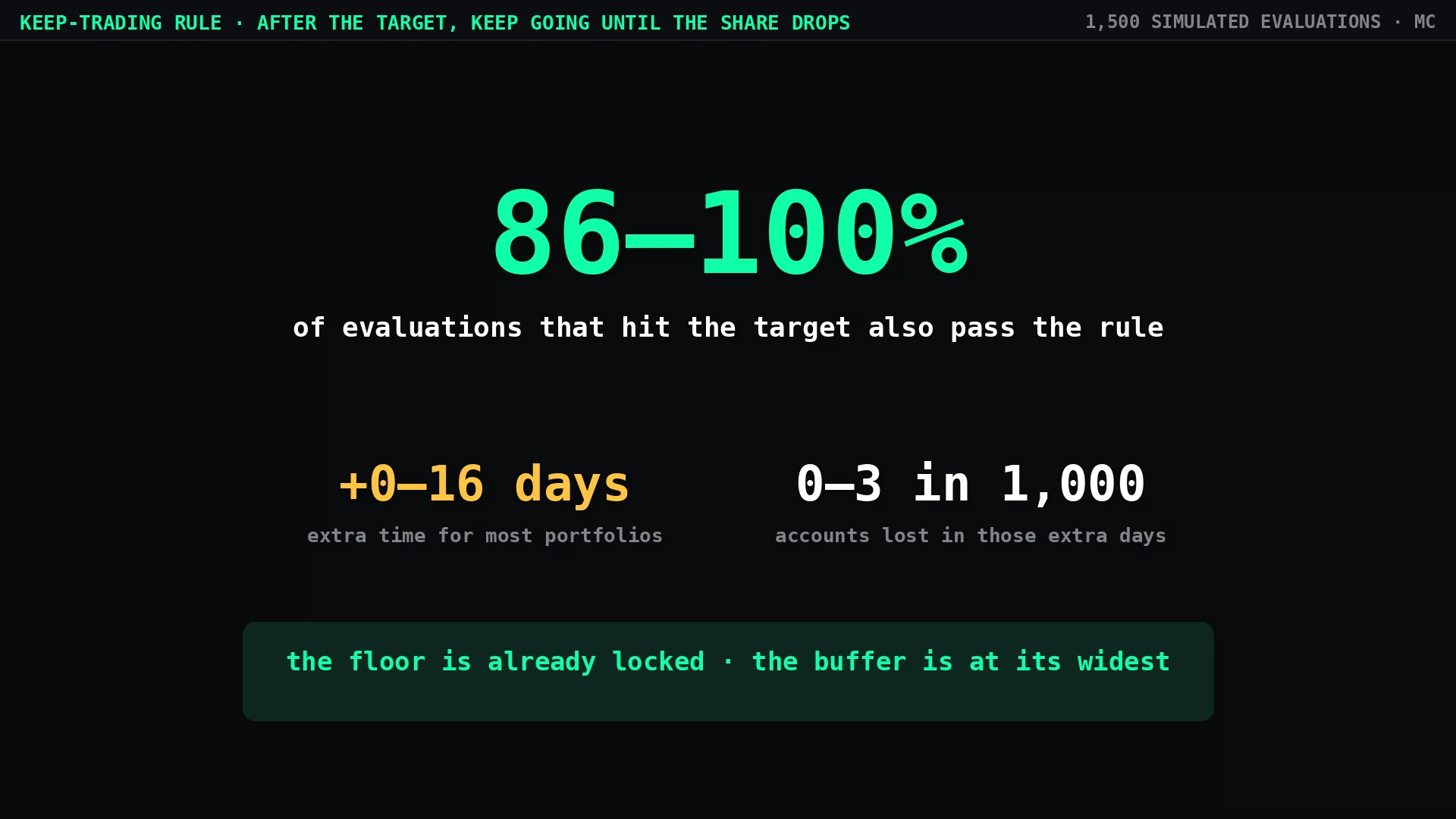
We ran 1,500 simulated evaluations for every portfolio in the catalog, and applied the keep-trading version of the rule at 30%, 40% and 50%.
- Of evaluations that hit the target, 86 to 100 percent also pass the rule.
- For most portfolios, that costs zero to sixteen extra days after the target.
- Accounts lost during those extra days: zero to three in a thousand, on every portfolio and every threshold.
Why the extra days are almost free
That last number looks too good, so it is worth explaining. The extra days happen at the safest point in the account’s life.
On futures accounts with an end-of-day trailing floor, by the time you reach the profit target the floor has usually already locked at its final level. On forex accounts with a static floor, your buffer at the target is the target plus the original limit, roughly twice the room you started with. Either way, you are trading the extension with more room than you will ever have again.

The strict rule is a different story
If your account applies the rule strictly at the moment of the target, the shape of your profit matters much more. Steadier portfolios pass far more often: our two-strategy portfolios pass a strict 40% check in roughly 65 to 97 percent of simulated evaluations.
The reason is timing. A portfolio that reaches the target quickly has fewer days in the window, and in a short window any single good day carries more weight. Speed and consistency pull against each other under a strict rule.
A side effect worth knowing: winning days
Many accounts also require a minimum number of winning days. Here the same mechanics work in your favour. Our four-strategy portfolios reach five winning days of $200 or more in a median of about 23 calendar days; most two-strategy portfolios take roughly 28 to 31. Several strategies winning on the same day is exactly what collects qualifying days quickly.
How to check your own account
- Find out whether your consistency rule is strict or keep-trading. It is usually in the evaluation or payout rules, not the headline summary. Some firms have no consistency rule at all — 24 firms checked.
- Put your total profit and your best day into the calculator with your threshold.
- If it fails, read the "total needed" figure. Under a keep-trading rule, that is how much more ordinary trading you need. Under a strict rule, it tells you how far off your profit shape is.
Methodology
Forecast: Monte Carlo with 1,500 simulated evaluations per portfolio, 5-day block bootstrap, current published compositions. Input is the trade record modeled to 31 March 2026 and live from 1 April 2026, on the same rule sets. Targets: futures $3,000 / $6,000 / $9,000 by account size, forex $10,000. The 100K-Growth March 2026 example sits in the modeled window. Details on the methodology page.
The rule is the filter. The Playbook shows what fits through it.
Which configurations fit tight daily limits, trailing floors and consistency rules — sized to the drawdown, not the balance. One PDF, then our letters with what the systems did.
By email, from Puerto Viejo, Costa Rica. Unsubscribe anytime.
Related
- Strategies sized to these rules: Topstep 50K, Apex 50K, MyFundedFutures 50K, Tradeify 50K, Lucid 50K
- Prop firm minimum trading days: rules by firm
- Prop firm consistency rules by firm (2026): thresholds, stages, and who has none
FAQ
Which prop firms have no consistency rule?
On the evaluation: Apex, Bulenox, Phidias, MyFundedFutures Rapid and Pro, Lucid Pro, Alpha Futures Zero, Maven standard challenges, FTMO 2-Step, Brightfunded and others; several of them check it at payout instead. The full 40-firm list by stage is on the no-consistency-rule page.
Does the consistency rule reset after a payout?
At most firms yes: the window restarts with the next payout cycle, so a large day early in a cycle is the hardest to clear. A few firms measure since account opening; the stage and window are on each rules card.
Why do systematic strategies fail it?
One outsized winning day against several flat days. A strategy with a 40% win rate and 3:1 winners produces exactly that shape; the fix is more trading days, not smaller trades, because every green day raises total profit and lowers the best-day share.
What is the consistency rule in prop firm trading?
It caps how much of your total profit can come from a single trading day. The calculation is largest single-day profit divided by total profit. If the result exceeds the firm's threshold, typically 20% to 50%, the payout is blocked until your profit distribution evens out. On most firms it delays a withdrawal rather than failing the account.
What is the TradeDay consistency rule?
TradeDay applies a consistency requirement during the evaluation but has no consistency rule on funded accounts, which puts it among the more permissive firms for traders whose returns arrive in uneven daily amounts. Earn2Trade and Take Profit Trader also drop the rule once funded.
What is Apex's consistency rule in 2026?
Apex runs two thresholds at the same time. Accounts purchased after 1 March 2026 use a 50% rule on funded Performance Accounts. Accounts purchased before that date keep the legacy 30% rule. Neither applies during the evaluation. Exceeding the threshold blocks the payout request; the account stays active.
Does breaking the consistency rule fail my account?
On most futures firms, no. It blocks the payout request until the ratio falls below the threshold, and you keep trading in the meantime. Check the specific firm, as the treatment is not universal.
How do I calculate how much one day can earn?
Multiply your total profit since the last payout by the threshold. At 50% on $3,000 of profit, your best day may be at most $1,500. Inverted: to unlock a payout after a large day, you need best-day profit divided by the threshold in total profit.
Verified July 2026. Prop firm rules change often and several firms rewrote their rulebooks in 2026. Apex in particular runs two different thresholds depending on when the account was purchased. Confirm every figure on the firm’s official site before purchasing an evaluation.
Performance figures are a combination of live-tracked and modeled results. Past performance does not guarantee future results. Not financial advice.