Automated trading strategies for prop firms: ten systems, ten trades
An automated trading strategy on a prop firm account places entry, stop and target in the same moment and does not touch the trade afterwards. Puravida Edge filmed ten of its strategy families taking one modeled trade each: six reached the target, one closed flat, one took a partial win and then its stop (source: Watch It Trade, October 2026).
Watch page with full transcript →
What do automated trading strategies do on a prop firm account?
They turn a trading idea into conditions, and conditions into orders. A setup builds; a list of conditions either lines up or it does not; when it does, the order goes in with its stop and target already attached. Nobody reads the morning, nobody takes a second look, nobody moves a stop because they are nervous. On a prop firm account that is the whole point: the trade that breaks a daily limit is almost always the one somebody managed by hand.
Which ten strategy families are in the video?
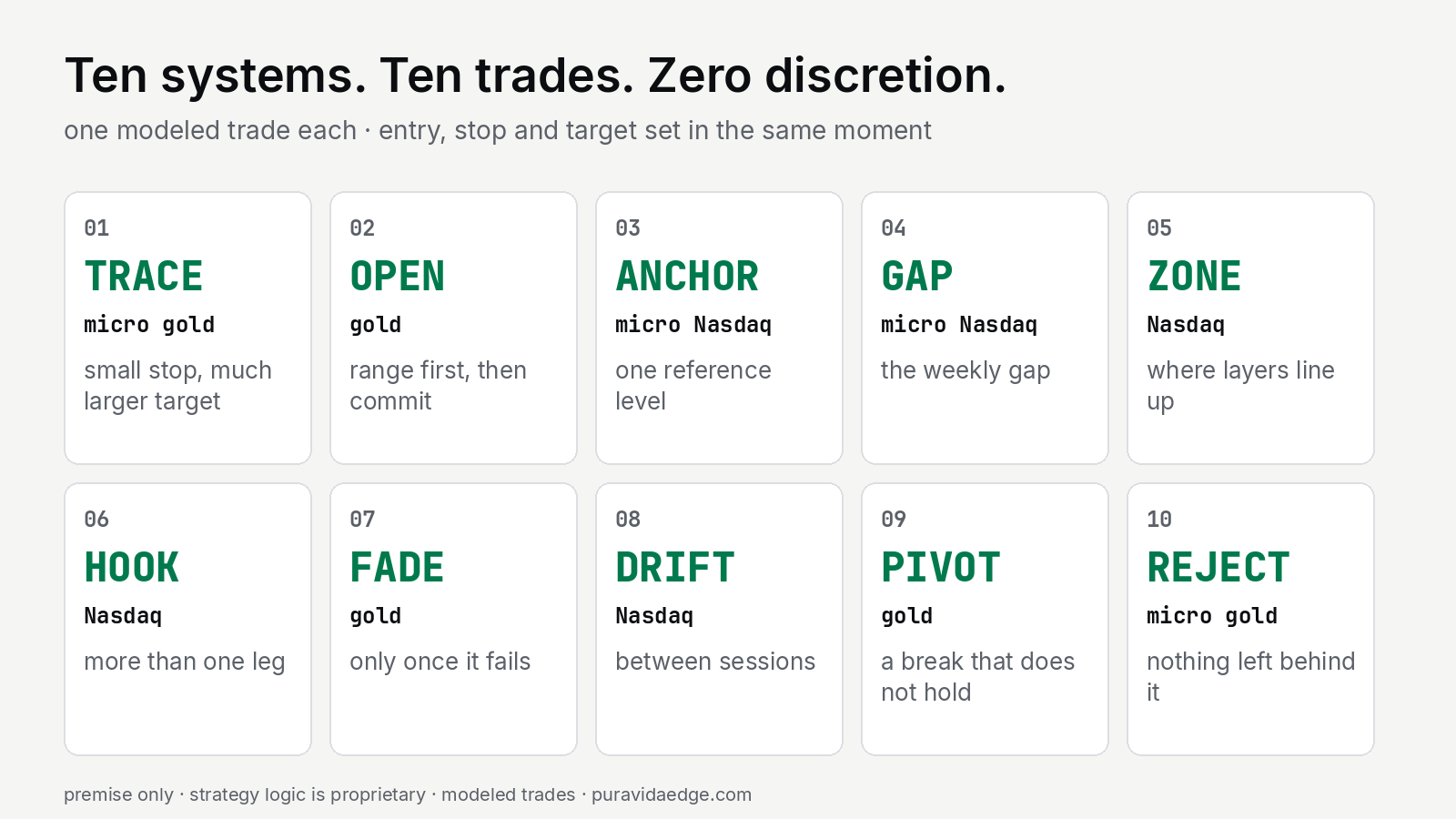
| # | Family | Instrument | Premise |
|---|---|---|---|
| 1 | Trace | micro gold (MGC) | asymmetric setups: a small stop, a much larger target |
| 2 | Open | gold (XAU) | range expansion at the open; commits only when the session qualifies |
| 3 | Anchor | micro Nasdaq (MNQ) | built around one session reference level; nothing is chased |
| 4 | GAP | micro Nasdaq (MNQ) | the weekly gap from Friday's close to the new week's open |
| 5 | Zone | Nasdaq (NAS) | pullbacks only where several independent layers line up |
| 6 | Hook | Nasdaq (NAS) | a multi-leg liquidity sweep that needs more than one leg of confirmation |
| 7 | Fade | gold (XAU) | stays out while a move is orderly, trades against it once it visibly fails |
| 8 | Drift | Nasdaq (NAS) | the bias between sessions, closed on a fixed schedule |
| 9 | Pivot | gold (XAU) | a false break at a key level: a move through it that does not hold |
| 10 | Reject | micro gold (MGC) | an exhausted, overextended move with nothing left behind it |
The table shows the premise of each family, not its rules. Entry conditions, filters and exit logic are proprietary and hardcoded.
What happened in the ten trades?
| Outcome | Families |
|---|---|
| Target reached | Trace, Open, Anchor, GAP, Pivot, Reject |
| Closed flat | Zone |
| Partial win, then stop | Hook |
| No declared result in the video | Fade, Drift |
One modeled trade per system is a demonstration, not a track record. The track record lives in the monthly results on each strategy page and on the PVE Index.
Why does it matter that entry, stop and target go in together?
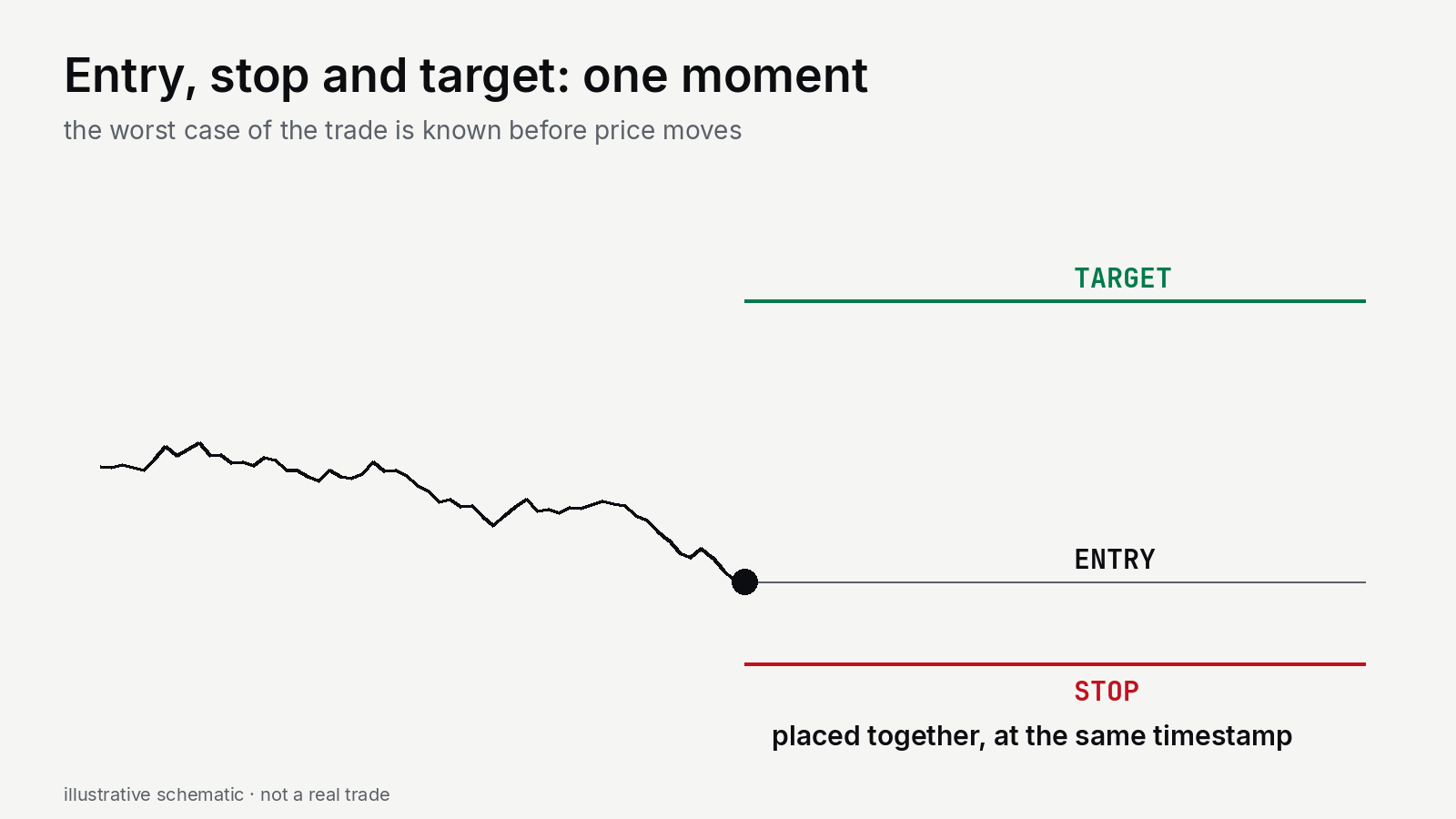
Because the worst case of every trade is known before price moves. Add that across an account and the worst day becomes something you can measure rather than something that happens to you. On the PVE Index Forex version, the worst live day was $1,469 against a $5,000 daily loss limit (live layer, April – September 2026, source: PV_EDGE Master Data). The mechanics of that limit are in the prop firm daily loss limit explained guide, and you can check your own sizing in the daily loss limit calculator.
Is running ten strategies on one prop firm account ten times the risk?
No, if each one is sized by its own volatility and capped at the risk budget it would carry alone. On the PVE Index Forex version that is 16 tracks, and the largest single share of risk is 9.6% (weights as of 2026-09-30). On the Futures version it is 15 tracks; one contract is the smallest step, so the shares run lumpier.
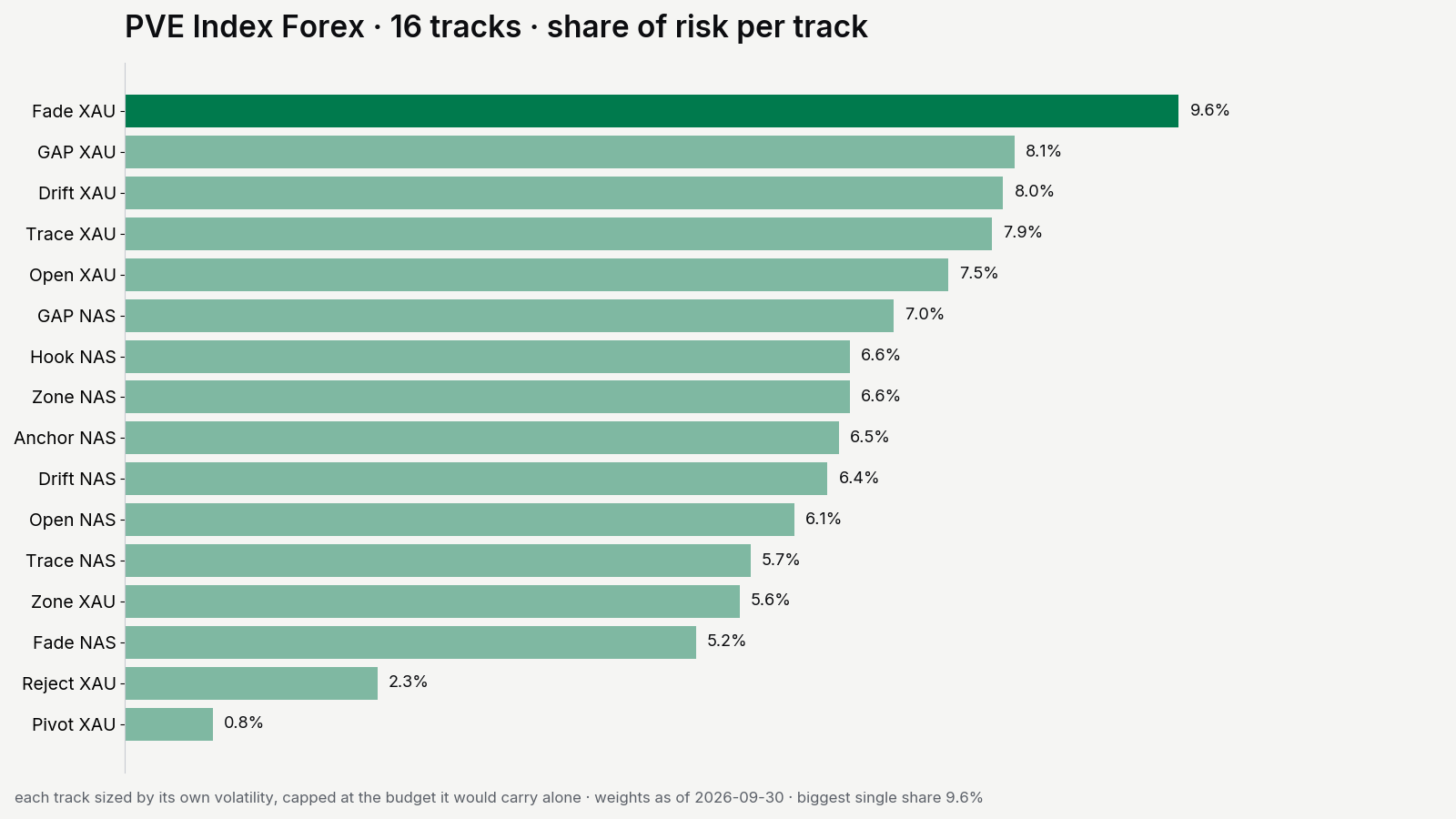
All ten families run together on one account in the PVE Index. Smaller sets on one account start from two strategies in the portfolios.
The systems the alerts come from.
Every strategy and portfolio that runs on TradingView, with the preset per account tier. One PDF, then our letters with what the systems did.
By email, from Puerto Viejo, Costa Rica. Unsubscribe anytime.
Related
FAQ
Does the video show the strategy rules? No. It shows the premise of each family and one modeled trade from setup to exit. Entry conditions, filters and exit logic stay proprietary.
Are these live trades? They are modeled trades, one per family, chosen to show how each system behaves. Live results are published monthly on the strategy pages and the PVE Index.
Why did Hook take its stop after a partial win? Because the exit comes from the system itself. A stop placed with the entry is the same rule whether the trade ends green or red.
What does "no discretion" mean in practice? No one decides anything during the trade: the order, its stop and its target are placed together, and nothing is moved afterwards.
Modeled trades. Live results (April – September 2026) are a separate layer. Hypothetical performance; past results do not guarantee future returns. Not financial advice.